

What Is Skin Barrier Damage? The Signs, Causes, and How to Repair Them
Does your skin ever feel tight after you wash it? Does it sting or burn when you apply products that used to feel fine? Maybe it is flaky in some places, oily in others, and breaking out in ways it never did before. If any of that sounds familiar, I want you to hear this clearly: Your skin is not broken, and you are not doing everything wrong. Your skin barrier is simply asking for help.
I'm Kenzie Schumacher, the licensed esthetician here at Everyday Wellness in Wichita, and skin barrier damage is one of the most common things I see in my treatment room. It is also one of the most fixable. In this post, I'll walk you through what your skin barrier actually is, the signs that yours is impaired, the everyday habits that damage it, and the exact steps I recommend to repair it.
Key Takeaways
Your skin barrier is the outermost layer of your skin, and it keeps moisture in and irritants out.
Signs of damage include sensitivity, redness, stinging, flaking, dryness, and acne flares.
Over-exfoliation, too many active ingredients, stripping cleansers, environmental stress, and chronic stress are common causes.
Repair starts with a simple routine: gentle cleanser, moisturizer, and daily SPF.
Pause all exfoliants for one to two weeks, then reintroduce actives slowly.
What Is Your Skin Barrier?
Your skin barrier is the outermost layer of your skin. In clinical terms, it is called the stratum corneum, but I like to think of it as your skin's front door. When that door is solid and well sealed, good things stay in, and bad things stay out.
A healthy barrier does a few important jobs all day, every day. It keeps water inside your skin so it stays hydrated, plump, and comfortable. It defends against allergens, pollution, and other environmental stressors that try to get in. And it helps prevent the irritation and acne flares that show up when your skin's defenses are down.
When your barrier is working well, you mostly do not think about it. Your products absorb comfortably, your skin tolerates your routine, and your complexion looks calm. When your barrier is impaired, your skin starts sending signals. Loudly.
Signs Your Skin Barrier Is Damaged
Here is what an impaired barrier tends to look and feel like:
Sensitivity. Products that never bothered you suddenly sting or burn on application.
Flaking with oiliness. This combination confuses a lot of people. Your skin can be flaky and oily at the same time when the barrier is compromised, because your skin may produce more oil while it struggles to hold onto water.
Dryness and tightness. Your skin feels tight after cleansing, even before you towel off.
Redness. Your skin looks flushed or irritated, especially after you apply products.
Stinging. Even gentle products can sting on a compromised barrier.
Acne flares. When the barrier is down, irritation goes up, and breakouts often follow.
If you checked two or three of those boxes, keep reading. The next section is probably going to feel familiar.
What Causes Skin Barrier Damage?
Here is the part that surprises most of my clients: barrier damage is rarely caused by neglect. It is usually caused by effort. The people sitting in my chair with the most irritated skin are often the ones trying the hardest. More products, more steps, more activities, more exfoliation. The intention is great. The result is a barrier that never gets a chance to do its job.
Let's go through the most common causes one at a time.
Over-Exfoliation
Exfoliation has its place in a healthy routine, but it is easy to overdo. This includes both chemical exfoliants, like glycolic acid toners, and manual exfoliants, like scrubs and brushes. When you exfoliate too often or too aggressively, you are repeatedly thinning the very layer of skin that is supposed to protect you.
Too Many Active Ingredients
Actives are powerful, and that is exactly why they need to be used thoughtfully. If you are layering a vitamin C in the morning, a glycolic toner in the evening, and a retinoid on top of that, you are simply doing too much in a single day. Each of those ingredients can be wonderful on its own. Stacked together on a daily basis, they can overwhelm your skin.
A Stripping Cleanser
Your cleanser sets the tone for everything that follows. A cleanser that is too harsh, too foaming, or loaded with active ingredients can strip your barrier twice a day, every day. If your skin feels squeaky or tight after washing, that is not clean. That is stripped.
Environmental Stressors
Cold weather and low humidity pull moisture from your skin, which is why many people notice barrier issues flare in the winter. Over-washing is another quiet culprit. You only need to wash your face once or twice a day. More than that works against you.
Chronic Stress
This one matters more than most people realize. Chronic stress is a big part of modern life. We get overworked, we get overwhelmed, and we carry too many tasks through the day. That stress does not stay internal. It shows up on your skin, and it can absolutely contribute to a compromised barrier.
So if your skin has been acting up during a stressful season of life, that is not a coincidence. Your skin is often a mirror of what is happening beneath the surface, which is exactly why we take an inside-out approach to skin health here at Everyday Wellness.
Why You Cannot Push Through Barrier Damage
This is the most common mistake I see: pushing through is never the answer when you have an impaired barrier.
When skin starts flaking or breaking out, the instinct is to do more. Add another exfoliant. Dry out the breakouts. Layer on a new product you saw online. I understand the impulse completely, but with a damaged barrier, every one of those moves makes things worse. You are asking an injured layer of skin to tolerate more aggression, and it cannot.
Here is the principle to remember: calm the barrier before correcting it. We calm the redness, flakiness, and dryness first. Correction comes later. Healing the skin starts with a healthy barrier, because without one, your skin cannot properly receive the treatments and active ingredients you want to use. A healthy barrier also makes your skin more resilient going forward, so everything you do afterward works better.
How to Repair a Damaged Skin Barrier
The good news: repair is simpler than you might expect. In fact, simplicity is the entire strategy.
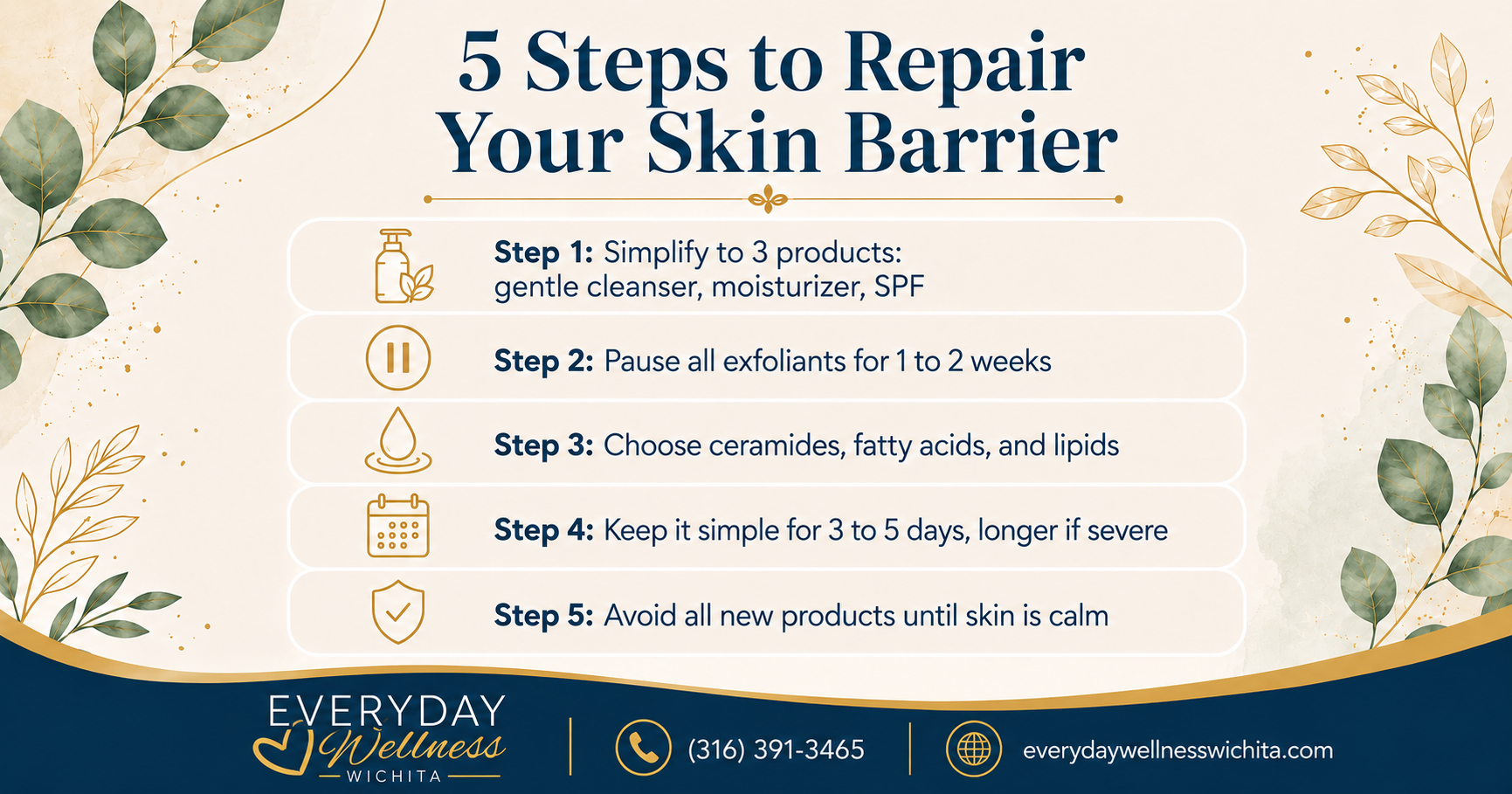
Step 1: Simplify Your Routine
We are getting back to basics. For the repair period, your routine is three things: a gentle cleanser, a moisturizer, and SPF. That is it. Keeping it simple gives your barrier the time and space it needs to repair itself and get back to looking and feeling healthy.
Step 2: Pause All Exfoliants
Cancel out all exfoliants, chemical and manual, for one to two weeks. No acids, no scrubs, no exfoliating brushes. I know that can feel uncomfortable if exfoliation is a part of your routine, but this pause is what allows the barrier to rebuild.
Step 3: Choose Barrier-Supporting Ingredients
While your skin repairs, you want your cleanser and moisturizer working with your barrier, not against it. Look for fatty acids, ceramides, and lipids, along with plenty of hydration. These are the building materials your barrier uses to restore itself.
Step 4: Keep the Simple Routine for Three to Five Days, or Longer
For mild cases, keep the routine very simple for three to five days. If your barrier damage is more severe, we keep the routine simpler for longer, depending on the severity. This is one of the places where having an esthetician in your corner really helps, because we can assess your skin and adjust the timeline for you.
Step 5: Avoid Anything New
During repair, do not introduce new products into your routine. No pushing through breakouts, no adding more exfoliants, and nothing that dries the skin out further. Your skin needs consistency and calm right now, not experiments.
The Products I Trust for Barrier Repair
Here are three products from our line at Everyday Wellness. Every one of these is chosen because it supports the barrier while it heals, instead of asking the skin to tolerate more.
Face Reality Barrier Balance Creamy Cleanser
This creamy cleanser contains probiotics that help support your microbiome, which works hand in hand with your barrier. It also contains amino acids that degrease the skin and remove makeup, oil, and environmental pollution without drying or disturbing the skin barrier. In other words, it cleans thoroughly while keeping everything you are trying to repair intact.
Alastin Ultra Calming Cleanser
This is a great product for sensitive skin. It helps promote hydration and contains silver mushroom, which is wonderful for skin hydration, along with oat protein extract that soothes and calms. It supports the skin's natural barrier function and helps with repair at the same time. Gentle, calming, and effective.
Alastin Regenerating Skin Nectar
This serum is a favorite of mine for all skin types. It is formulated without preservatives and without water, so it is all ingredient-based. The star is TriHex Technology, and here is how I like to describe it: think of your collagen and elastin as building blocks. As we age, those blocks slowly break apart. TriHex helps clear away the fragmented collagen we lose over time and then supports the rebuilding process, encouraging an environment for optimal skin recovery. It also contains Arnica Montana extract, which has calming properties, helps reduce redness, and helps protect the barrier from further damage.
If you are curious which of these would suit your skin best, that is exactly the kind of question I love answering during a facial or consultation. You can learn more about what we offer on our esthetic services page.
Why SPF Is Non-Negotiable During Repair
Let's talk about sunscreen, because during barrier repair, it is not optional. Your skin is especially vulnerable to UV damage when the barrier is impaired, and unprotected sun exposure can set your progress back and increase inflammation.
Daily SPF supports the healing process and helps slow down the inflammation you are seeing. I personally like a tinted sunscreen, but a mineral sunscreen is one of the best choices when your barrier is impaired, because it tends to be gentle and simple. Whichever you choose, the rule is the same: SPF every single day, rain or shine, indoors or out.
When and How to Bring Your Actives Back
Once your barrier has calmed down, your redness has settled, and products no longer sting on application, you can begin reintroducing your active ingredients. The keyword is slowly.
Start with one active at a time, one to three times a week. Watch how your skin responds. If it stays calm and comfortable, you can gradually build back up toward your full routine. If irritation returns, scale back and give your skin more time. Think of it like returning to the gym after an injury. You do not jump straight back to your heaviest weights. You rebuild gradually, so you do not end up right back where you started.
This is also the perfect moment to rethink which activities truly earn a place in your routine. Many of my clients discover that a simpler routine with fewer, well-chosen activities gives them better skin than the ten-step routine that damaged their barrier in the first place.
You Do Not Have to Figure This Out Alone
If your skin has been irritated, reactive, or confusing lately, here are two things to consider. First, barrier damage is incredibly common, and it does not mean you have failed at skincare. Second, you do not have to fix it by yourself.
When you book a facial with me, we look at your skin together, talk through your current routine, and build a repair plan that fits your skin, your lifestyle, and your goals. Sometimes the fix is as simple as removing two products. Sometimes we uncover something deeper, like chronic stress or an internal imbalance, and that is where the bigger Everyday Wellness team can support you from the inside out.
Your skin wants to be healthy. Sometimes it just needs us to get out of its way, give it the right support, and let it do what it was designed to do.
If you want to dive in deeper, please take a look at our previous posts in this series:
Healthy Skin Starts on the Inside
What Does Acne Placement Actually Mean
Why Facials Are More Than Relaxation
The Skincare Mistakes You're Making
The Biggest Mistake People Make with Hair Loss
Alma TED: The Pain-Free Hair Restoration Treatment
Frequently Asked Questions
What is the skin barrier?
Your skin barrier is the outermost layer of your skin, called the stratum corneum. It keeps moisture in and keeps allergens, pollution, and irritants out.
How do I know if my skin barrier is damaged?
Common signs include sensitivity, stinging or burning when you apply products, redness, flaking paired with oiliness, dryness, tightness, and acne flares.
What causes skin barrier damage?
The most common causes are over-exfoliation, using too many active ingredients in one day, stripping cleansers, environmental stressors like cold weather and low humidity, over-washing the face, and chronic stress.
How long does it take to repair a damaged skin barrier?
It depends on the severity. A simplified routine for three to five days helps mild cases, while more severe damage can take one to two weeks or longer. A consultation can help determine the right timeline for your skin.
Can I keep exfoliating while my barrier repairs?
No. Pause all exfoliants, chemical and manual, for one to two weeks. Reintroduce them slowly once your skin has calmed, starting one to three times a week.
Do I really need SPF every day during barrier repair?
Yes. Your skin is especially vulnerable to UV damage when the barrier is impaired. Daily SPF, ideally mineral, supports healing and helps slow inflammation.
Should I see an esthetician for skin barrier damage?
If your skin is not improving with a simplified routine, or you are unsure what caused the damage, a professional assessment can save you weeks of guesswork. We can evaluate your skin and build a personalized repair plan together.
Ready to feel like yourself again? Let's talk.
Call us: (316) 391-3465
Services: Bio-Identical Hormone Replacement Therapy (BHRT), Medical Weight Loss, Hair Restoration, Allergy Management, Esthetics
Location: 5112 E Central Ave, Wichita, KS 67208