

Alma TED: The Pain-Free Hair Restoration Treatment
If you have been losing hair and dreading the idea of needles in your scalp, take a breath. There is an option that does not involve a single needle. It is called Alma TED, and it is one of the treatments patients ask about most often at Everyday Wellness Wichita.
Here is an honest look at exactly what it is, how it works, what the research actually says, and just as importantly, what it cannot do. No hype. No miracle promises. Just the information you need to decide whether it is worth a conversation.
Key Takeaways
Alma TED is a needle-free, pain-free hair treatment that uses ultrasound and air pressure to deliver a growth serum into the scalp.
It is best for early to moderate thinning and shedding, not for areas that are already fully bald.
The idea behind it, using ultrasound to deliver a serum, is well studied. Research on Alma TED by name is still in its early stages.
Results are not permanent and usually need maintenance sessions.
A consultation is the only way to know if it fits your hair, your history, and your goals.
What Alma TED Actually Is
Alma TED stands for TransEpidermal Delivery. The name sounds technical, but the idea is simple. Your scalp has a protective outer layer that does its job a little too well. It blocks most of what you put on top of it, including the serums that are supposed to help your hair.
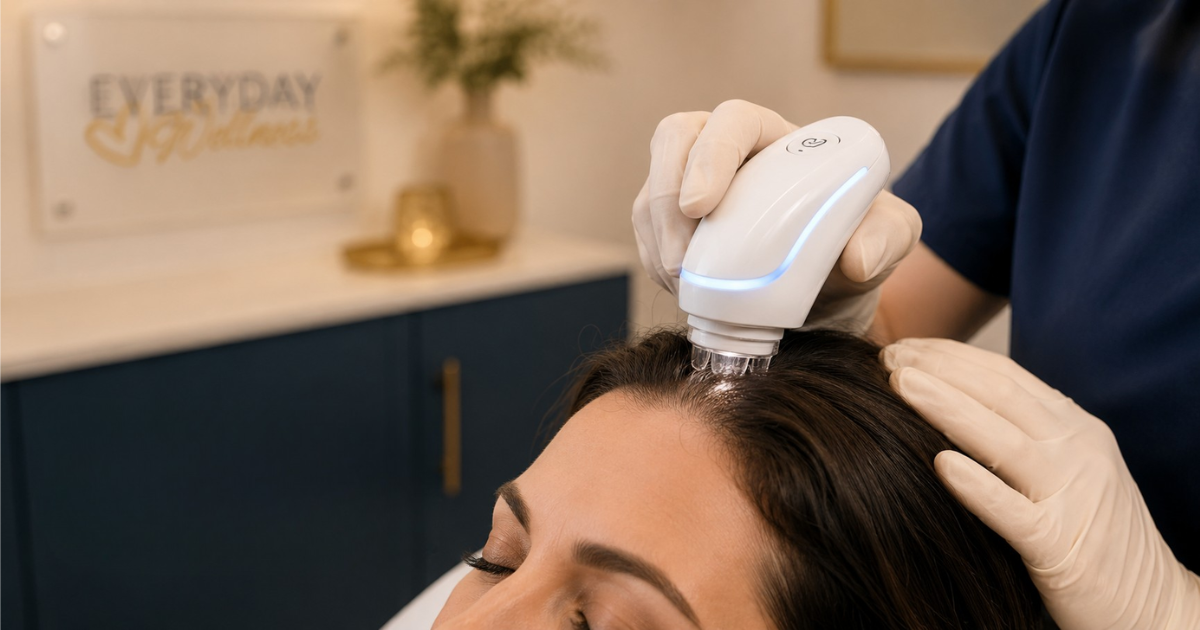
Alma TED uses low-frequency ultrasound waves and gentle air pressure to open tiny temporary channels in that outer layer. Through those channels, a serum full of growth factors and peptides reaches the hair follicles underneath. No needles. No incisions. No numbing required.
The channels it creates are temporary. They close on their own within hours as the skin's natural barrier restores itself. There is no permanent change to your scalp.
Most people describe the treatment as a warm, vibrating sensation, almost like a scalp massage. Some notice a faint ringing in the ears during the session because the ultrasound conducts through bone. That is normal, and it stops the moment the session ends.
Why People Choose It
The biggest reason is right there in the name of this post. It does not hurt.
A lot of people who could benefit from in-office hair treatments avoid them entirely because they are afraid of needles or pain. If that is you, you are not alone, and it is not silly. Fear of a treatment is a completely valid reason to put it off. Alma TED removes that barrier.
Beyond comfort, here is what draws people to it:
It is non-invasive. There is no recovery, no downtime, and you can go back to your day.
Sessions are short. A typical treatment runs about 20 to 30 minutes.
It pairs well with other treatments. It can work alongside a broader hair restoration plan rather than replacing it.
Comfort and convenience are real benefits, and they matter. The goal of Alma TED, though, is hair thickening and regrowth. That is what the treatment is designed to deliver, and comfort is simply part of how it gets there, not a guarantee of the result. Keep both of those truths in mind.
How It Works, In Plain Terms
There are two stages to an Alma TED session.
Stage one is priming. The device passes over the scalp using ultrasound and air pressure. This is the step that opens those temporary channels in the skin's outer layer. Without this step, even the best serum would mostly sit on the surface and get blocked. This is what turns a topical product into something that can actually reach deeper.
Stage two is delivery. A serum containing growth factors and peptides is applied, and the device helps drive it down toward the follicles. The goal is to support a healthier scalp environment and give the follicles better conditions to do their work.
Here is why the idea behind it is well-founded. Using ultrasound to support medication absorption through the skin is not new or fringe. Researchers have been studying it for decades. One study, a few years back, found that adding ultrasound resulted in noticeably more hair-growth medication being absorbed into the skin, and grew more hair in lab and animal studies. That study did not use the Alma TED device itself, but it supports the technology that Alma TED uses. If you want to check the sources, they are all listed at the bottom of this post.
The technology has been proven, and there are many client stories demonstrating effective hair growth. However, research on the Alma TED device by name is still limited, and there is no long-term data yet. The early findings look promising. There just are not years of large studies behind it, the way there are for some of the older treatments.
Who It Is Right For, And Who It Is Not
Many people can benefit from Alma TED, but it is not for everyone.
Alma TED may be a good fit if you are dealing with:
Early to moderate thinning
Increased shedding
A widening part
A scalp that still has active follicles, even if they are producing finer hair
Alma TED is not the right tool if:
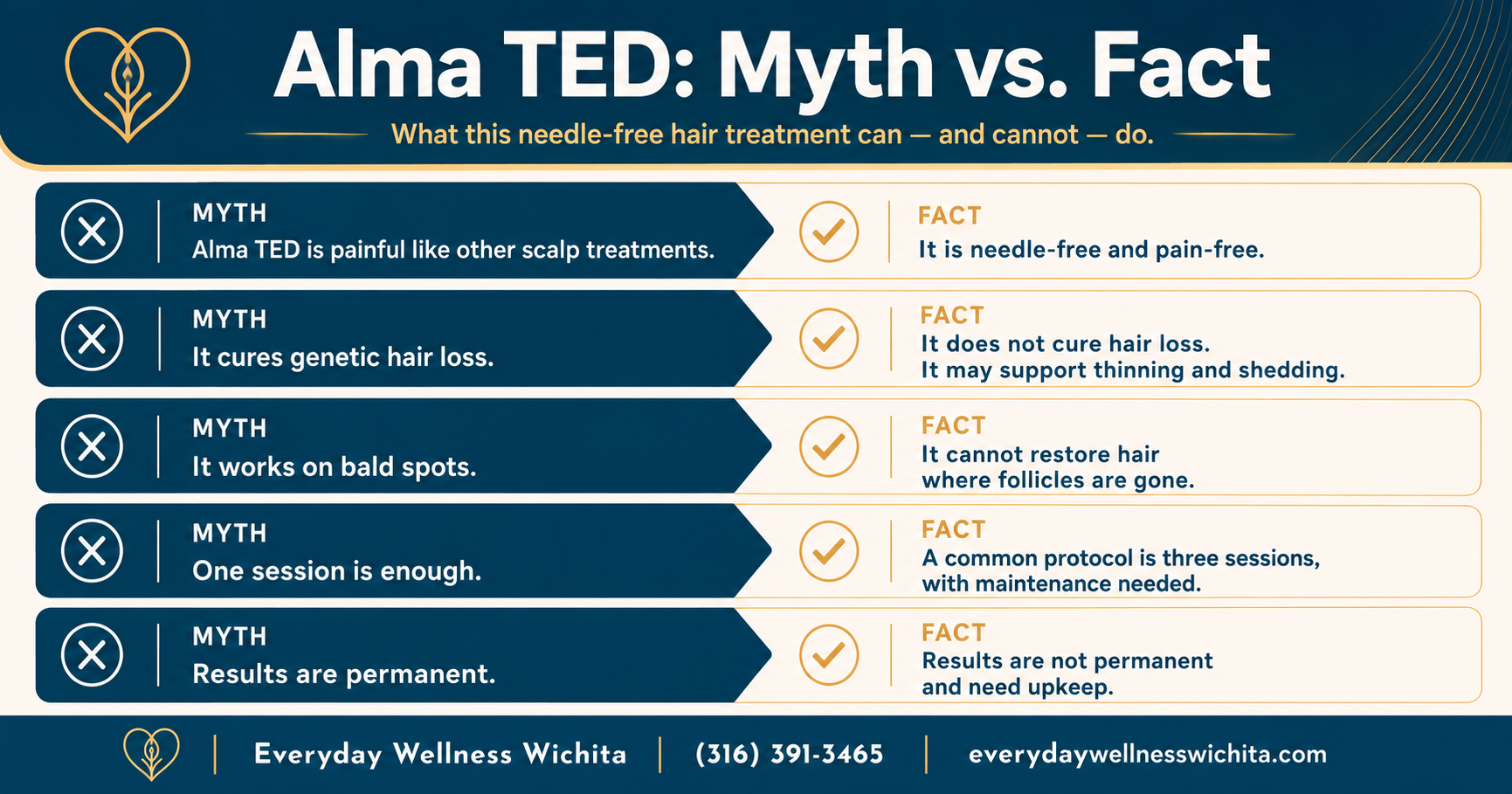
You are looking for a cure for genetic hair loss. It is not one.
You have completely bald areas. It cannot restore hair where the follicles are already gone. The only option for severely depleted areas is a hair transplant.
You expect a one-and-done fix. Results require maintenance.
None of this is meant to talk anyone out of it. The point is that the people who are happiest with their results are the ones who started with realistic expectations. Hair restoration is rarely about one treatment. It is about the right combination for your situation.
What Results Actually Look Like
Honest expectations matter here.
A common protocol is three sessions spaced about a month apart, with some people noticing changes within the first month. Results vary from person to person. Some see meaningful improvement in density and scalp health. Others see more modest changes.
Results are also not permanent. To maintain them, most people need ongoing touch-up sessions. Think of it less like flipping a switch and more like tending a garden. You keep at it, and it keeps responding.
If you have looked into PRP, which is another non-surgical option, you may be weighing the two. They both deliver growth factors to the scalp, but they work differently, and one is not automatically better than the other. For some people, PRP produces more noticeable results, and for others, the needle-free comfort of Alma TED is the deciding factor. This is exactly the kind of thing a consultation sorts out.
How It Fits Into a Bigger Plan
At Everyday Wellness Wichita, no single treatment is viewed in isolation, and hair is no exception. What is happening on your scalp is often connected to what is happening inside your body.
Hormones, stress, nutrition, and overall health all play a role in how your hair grows. That is the whole idea behind the inside-out approach at Everyday Wellness Wichita. A treatment like Alma TED can support your scalp from the outside, while the team also looks at whether something internal is contributing to the thinning.
That is why a consultation matters so much. It is the step where the team actually figures out what is going on for you specifically, and whether Alma TED, something else, or a combination makes the most sense.
Frequently Asked Questions
1. Does Alma TED hurt? No. It is needle-free, and most people describe it as a warm, gentle, vibrating sensation. No numbing is needed.
2. How many sessions will I need? A common starting protocol is three sessions about a month apart, but the right number depends on your hair and your goals. That gets sorted out at your consultation.
3. How soon will I see results? Some people notice changes within the first month. Results vary, and patience helps. This is not an overnight fix.
4. Are the results permanent? No. Results are not permanent and usually require maintenance sessions to keep them up.
5. Can it regrow hair where I am already bald? No. Alma TED cannot restore hair in areas where the follicles are gone. For those areas, a hair transplant is the only option.
6. Is there any downtime? No real downtime. You can return to your normal day. The team will give you simple aftercare guidance, like avoiding washing or coloring your hair for the first 24 hours.
7. How is it different from PRP? Both deliver growth factors to the scalp. PRP uses your own blood and involves needles. Alma TED is needle-free and uses ultrasound. Neither is automatically better. It depends on you.
Want to Catch Up on the Series?
If you want to dive in deeper, take a look at the previous posts in this series:
Ready to Find Out If Alma TED Is Right for You?
If you have been holding off on hair restoration because you were scared it would hurt, this might be the conversation worth having. The Everyday Wellness Wichita team can sit down with you, look at what is actually going on with your hair, and help you find the right path. No pressure, and no needles required to find out.
Ready to feel like yourself again? Let's talk.
Book your consultation: https://everydaywellnesswichita.com/contact
Call us: (316) 391-3465
Services: Bio-Identical Hormone Replacement Therapy (BHRT), Medical Weight Loss, Hair Restoration, Allergy Management, Esthetics
Location: 5112 E Central Ave, Wichita, KS 67208
This content is for educational purposes only and is not medical advice. Treatment decisions should be made with a qualified healthcare provider who understands your symptoms, history, labs, and goals.
Sources
Liao, A. H., Lin, K. H., Chuang, H. C., Tsai, C. H., Lin, Y. C., Wang, C. H., Shih, C. P., & Liu, H. L. (2020). Low-frequency dual-frequency ultrasound-mediated microbubble cavitation for transdermal minoxidil delivery and hair growth enhancement. Scientific Reports, 10, 4338. https://doi.org/10.1038/s41598-020-61328-0
Xu, S., Zhou, L., Zhao, H., & Li, S. (2025). Advances in transdermal delivery systems for treating androgenetic alopecia. Pharmaceutics, 17(8), 984. https://doi.org/10.3390/pharmaceutics17080984
Charles Medical Group. (2026). Alma TED hair restoration non-surgical: How the two-stage ultrasound mechanism works. https://charlesmedicalgroup.com/plastic-surgery/alma-ted-hair-restoration-non-surgical-how-it-works/
Hims. (2025). Alma TED review: What a doctor thinks about this hair loss treatment. https://www.hims.com/blog/alma-ted-review