

The Skincare Mistakes You're Making That Are Actually Hurting Your Skin
Key Takeaways
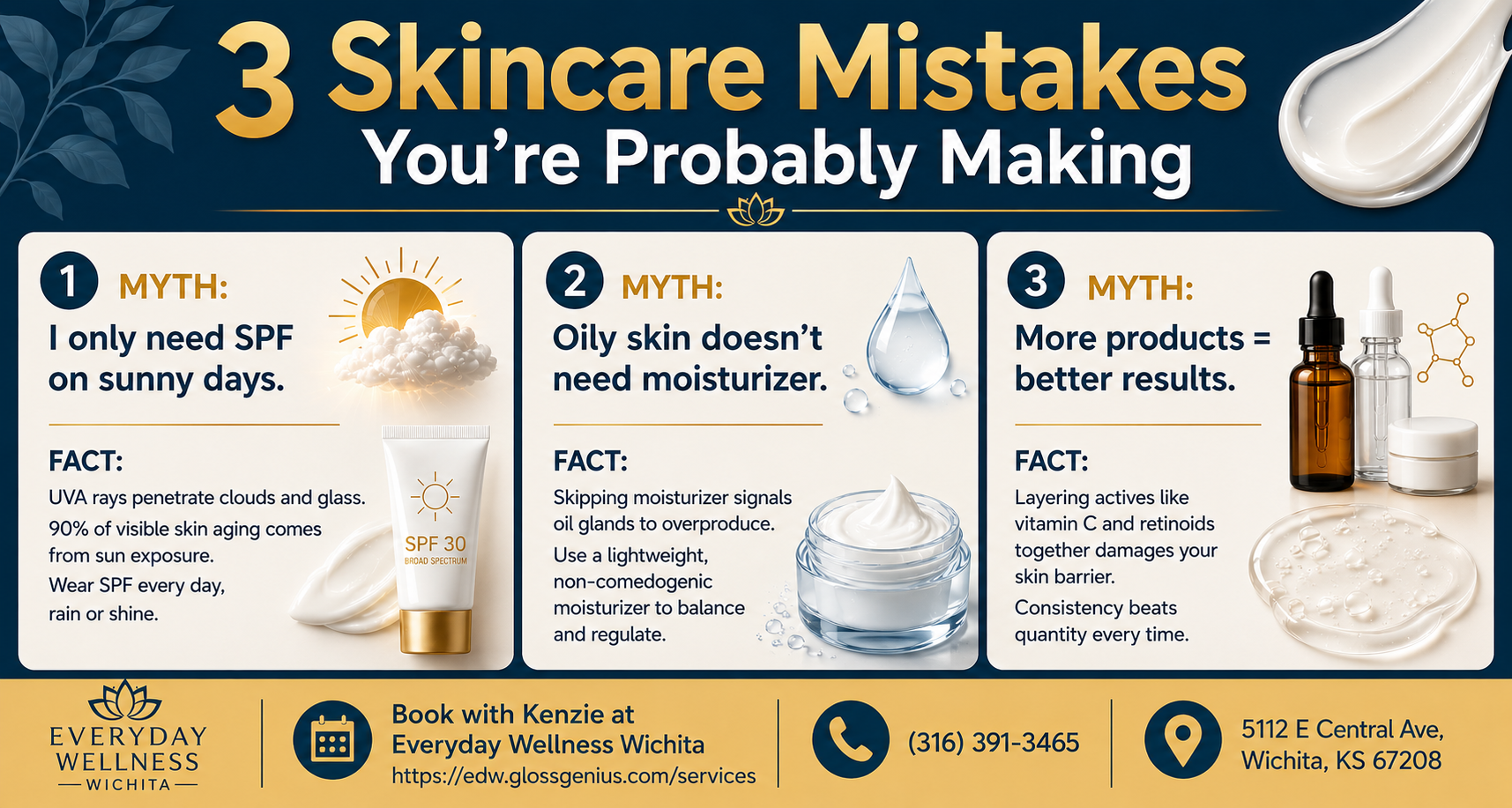
Skipping SPF on cloudy days is one of the fastest ways to age your skin. Sun exposure causes 90% of visible skin aging.
Oily skin needs moisturizer. Skipping it tells your oil glands to produce more oil, not less.
Layering too many active ingredients, especially vitamin C and retinoids, together can break down your skin barrier and cause irritation.
Consistency and balance beat quantity every time. A simple, well-matched routine will outperform a 10-step routine every time.
A professional consultation takes the guesswork out. You don't have to figure this out alone.
The Skincare Mistakes You're Making That Are Actually Hurting Your Skin
Picture this. You wake up, it's a gray morning. Maybe it's raining. You look out the window and think, "I don't need sunscreen today." So you skip it. You do the rest of your routine, head out the door, and don't give it another thought.
Or maybe your skin runs oily. You've been told your whole life that moisturizer will make it worse. So you've been skipping it for years, wondering why your skin still looks shiny and congested by noon.
Or maybe you've gone the other direction. You've invested in good skincare. You're using vitamin C, retinoids, AHAs, and a peptide serum. You layer them all on every morning because more is more, right?
I see these three patterns constantly in my treatment room. And I want to tell you something important: none of this is your fault. You're doing what made sense based on the information you had. But these three habits are quietly working against your skin, and once you understand why, you can't unsee it.
I'm Kenzie Schumacher, licensed esthetician at Everyday Wellness Wichita. My job is to help you build a routine that actually works for your skin, your lifestyle, and your goals. Let's talk about the three most common skincare mistakes I see, and what to do instead.
Mistake #1: Skipping SPF on Cloudy Days (or Any Day That Isn't "Sunny")
This is probably the single most widespread skincare myth I encounter. The logic makes intuitive sense. If there's no sun visible, there's no UV exposure. Right?
Wrong.
UVA rays, the ones responsible for premature aging and deeper skin damage, penetrate clouds. They also reflect off surfaces like pavement, water, snow, and glass. You can be sitting inside near a window and still be accumulating UV exposure. A cloudy day outdoors is not a protected day.
Here's the number that usually stops people in their tracks: approximately 90% of visible skin aging comes from sun exposure. Not genetics. Not time. The sun.
That means wrinkles, fine lines, dark spots, uneven skin tone, and loss of elasticity. Most of that is not inevitable. It's largely preventable. And the most effective, most affordable, most accessible prevention tool available to you is sunscreen, worn every single day.
SPF is not just a summer product. It is not optional on overcast days, winter days, or work-from-home days when you're near a window. Daily SPF use is the foundation of any serious anti-aging routine, and without it, everything else you're doing is working at a disadvantage.
What you should be doing: Apply a broad-spectrum SPF 30 or higher every single morning as the last step in your daytime skincare routine. Reapply if you're spending extended time outdoors. Make it non-negotiable, regardless of the weather forecast.
If you're not sure which sunscreen formula works best for your skin type, especially if you've struggled with white cast, breakouts, or a greasy finish from past formulas, that's exactly the kind of thing I can help you with in a consultation.
Mistake #2: Avoiding Moisturizer Because Your Skin Is Oily
This one is deeply ingrained. If you have oily skin, the idea of adding more moisture to it feels counterintuitive at best and terrifying at worst. You're already shiny. The last thing you want is more.
But here's what's actually happening when you skip moisturizer.
Your skin has a built-in moisture regulation system. When it detects that the surface is dehydrated, even if you produce a lot of oil, it responds by signaling your oil glands to produce more sebum to compensate. So when you skip moisturizer consistently, you're not reducing oil. You're triggering your skin to produce more of it.
Your skin's oil production and its hydration levels are two separate systems. Oil is produced by sebaceous glands. Water moisture is held in the skin's layers and protected by what's called the skin barrier. You can have an oily surface and a dehydrated skin barrier at the same time. In fact, this is extremely common in people with oily or acne-prone skin who avoid moisturizer.
When the skin barrier is compromised, you'll also notice more sensitivity, redness, and breakouts, because the barrier's job is to keep irritants out. A dehydrated, impaired barrier lets more in.
What you should be doing: Use a lightweight, non-comedogenic moisturizer formulated for oily or combination skin. Non-comedogenic means it won't clog your pores. The right moisturizer will hydrate without adding heaviness or shine, and over time, it will actually help regulate your oil production because your skin stops overcompensating.
Not all moisturizers are created equal, and the wrong one can absolutely make oily skin worse. This is one area where a professional recommendation based on your specific skin type makes a significant difference.
Mistake #3: Using Too Many Active Ingredients at Once
Skincare has had a real moment over the past few years. Ingredient literacy is up. People know what retinoids are. They've heard about vitamin C, niacinamide, AHAs, BHAs, and peptides. They're reading labels and investing in their routine.
But more ingredients do not equal better results. And in many cases, it causes real damage.
Active ingredients like retinoids, vitamin C, AHAs, and BHAs are potent. They work by prompting a cellular response in your skin. That's what makes them effective. But when you layer multiple actives together, especially ones that work in conflicting ways or at conflicting pH levels, you can get irritation, inflammation, and breakdown of the skin barrier.
A very common example: vitamin C and retinoids used together in the morning. Both are active, both are powerful, and both can be irritating individually. Using them together does not double your results. It's asking your skin to manage two aggressive agents simultaneously, which often leads to redness, peeling, sensitivity, and a compromised barrier.
A compromised skin barrier is not a minor inconvenience. It means your skin's first line of defense (the thing that keeps bacteria, pollutants, and allergens out) is weakened. Once that's damaged, everything else in your routine becomes harder to tolerate. Products you used to be fine with will suddenly sting or cause reactions. It can take weeks to repair.
What you should be doing: Focus on consistency over quantity. A simple, well-matched three to four-step routine used consistently will outperform a 10-step routine every time. Introduce one new active at a time, give it six to eight weeks before evaluating, and learn which ingredients play well together versus which ones need to be separated into morning and evening use.
This is also an area where ingredient knowledge matters enormously, and working with a licensed esthetician can save you months of trial and error.
The Real Cost of Getting This Wrong
I want to be honest with you about something. These mistakes don't just slow your results. Over time, they can cause cumulative damage that takes real effort to reverse.
Chronic sun exposure without SPF accelerates photoaging in ways that topical products can only partially address. A consistently compromised skin barrier becomes chronically sensitive skin. Long-term ingredient overload can cause what some people describe as their skin "turning on them," suddenly reacting to products it used to tolerate.
None of this is meant to scare you. Most skin can recover and respond beautifully once you give it what it actually needs. But understanding the stakes helps explain why these habits matter.
What Good Skincare Actually Looks Like
Good skincare is not complicated. It does not require dozens of products or a deep knowledge of cosmetic chemistry. What it requires is understanding your own skin, using the right products for your specific needs, and being consistent.
A solid basic routine for most skin types includes a gentle cleanser, a moisturizer appropriate for your skin type, SPF every morning, and one or two targeted actives introduced slowly and intentionally. That's it. Everything else is optional and should be added with purpose.
The problem is that "the right products for your specific needs" looks different for every person. What works beautifully for someone with dry, sensitive skin can be completely wrong for someone with oily, acne-prone skin. What works at 25 often needs to be adjusted at 40. What worked before a major hormonal shift (a pregnancy, perimenopause, going on or off a medication) may not work after.
This is why I think professional guidance is genuinely worth it. Not because you can't figure anything out on your own, but because a professional can cut through the noise and give you a clear, specific answer about your skin, usually in one appointment.
Why Everyday Wellness Is Different
At Everyday Wellness Wichita, esthetics is built on the same inside-out philosophy that Jen uses in her medical practice. We're not here to sell you a product. We're here to understand your skin, understand what's happening internally that may be affecting it, and build a plan that addresses the whole picture.
Kenzie's approach is rooted in that same philosophy. She's not going to hand you a bag of products and send you home. She's going to talk through your skin history, your current routine, your lifestyle, and your goals. Then she'll tell you exactly what's working, what isn't, and what to do instead.
If you've been spinning your wheels with skincare, spending money on products that aren't delivering, and struggling with oiliness, breakouts, or sensitivity, this is the appointment that can actually change things.
Common Questions About Skincare Mistakes
1. Does SPF in my makeup count, or do I need a separate sunscreen?
SPF in makeup provides some protection, but most people do not apply enough makeup to reach the SPF level listed on the label. A dedicated sunscreen applied before makeup is always the more reliable approach.
2. Will moisturizer make my acne worse?
The wrong moisturizer can. A heavy, comedogenic formula can clog pores and contribute to breakouts. A lightweight, non-comedogenic formula will not only not clog pores but will also support your skin barrier, which helps prevent breakouts over time.
3. Can I use vitamin C and retinoids if I keep them in separate routines?
Yes. Vitamin C works well in the morning alongside SPF. Retinoids are best used at night. Separating them into AM and PM routines is a common and effective approach. The problem arises when they're layered together in the same application.
4. How long does it take to repair a damaged skin barrier?
It depends on the severity, but most people see improvement within two to four weeks when they simplify their routine, stop using harsh actives, and focus on hydration and protection. A professional assessment can speed up that process significantly.
5. How do I know which active ingredients are safe to use together?
This is genuinely complex, and the answer depends on the specific formulations you're using, your skin type, and your skin's current condition. This is one of the best reasons to book a consultation rather than rely on general guidance from the internet.
6. Is professional skincare worth the investment if I'm already spending money on products?
In most cases, yes. A consultation can help you identify what's not working in your current routine and stop the cycle of buying products that don't deliver. Most people find that a professional recommendation results in a simpler, more affordable routine that actually performs.
Ready to stop guessing and start seeing results?
Book your skincare consultation with Kenzie at Everyday Wellness Wichita. She'll look at your skin, your routine, and your goals, and she'll give you a clear plan that actually fits.
Book with Kenzie: https://edw.glossgenius.com/services
Call us: (316) 391-3465
Services: Esthetics, Bio-Identical Hormone Replacement Therapy (BHRT), Medical Weight Loss, Hair Restoration, Allergy Management
Location: 5112 E Central Ave, Wichita, KS 67208
If you want to dive in deeper, please take a look at our previous posts in this series:
Healthy Skin Starts on the Inside (Episode 1):
https://everydaywellnesswichita.com/post/healthy-skin-starts-inside-outWhat Does Acne Placement Actually Mean (Episode 2):
https://everydaywellnesswichita.com/post/what-does-acne-placement-actually-meanWhy Facials Are More Than Relaxation (Episode 3):
https://everydaywellnesswichita.com/post/facials-more-than-relaxation-root-cause-skin-wichita