
Why Facials Are More Than Relaxation: The Root Cause Approach to Beautiful Skin
Most people book a facial when they want to unwind. A little quiet time, soft music, warm towels, and an hour away from everything demanding their attention. And that part is completely real and completely valid.
But if that's all you think a facial does, you're missing most of the story.
At Everyday Wellness Wichita, every facial is designed to do something much deeper than refresh your complexion. It works with your lymphatic system, your nervous system, and the connection between chronic stress and your skin. Understanding what's actually happening during those 60 minutes changes the way you think about skincare entirely.
My name is Kenzie, and I'm the licensed esthetician here at Everyday Wellness. I came to holistic esthetics because I saw firsthand how much conventional skincare misses when it focuses only on the surface. Your skin is not separate from the rest of your body. What shows up on your face reflects what's happening inside, and that's the foundation of everything I do in the treatment room.
So let's walk through what a facial is really doing for you.
Key Takeaways
Facials use a technique called effleurage that actively supports lymphatic drainage
Your lymphatic system removes toxins and reduces puffiness, but it needs manual movement to do its job
The neck and jawline are the most important areas for lymphatic drainage during a facial
Facial massage shifts your nervous system from fight-or-flight into rest-and-digest
Chronic stress is one of the most common and overlooked drivers of skin problems
Regular facials every four weeks work with your skin's natural cell turnover cycle for cumulative results
It Starts With Effleurage
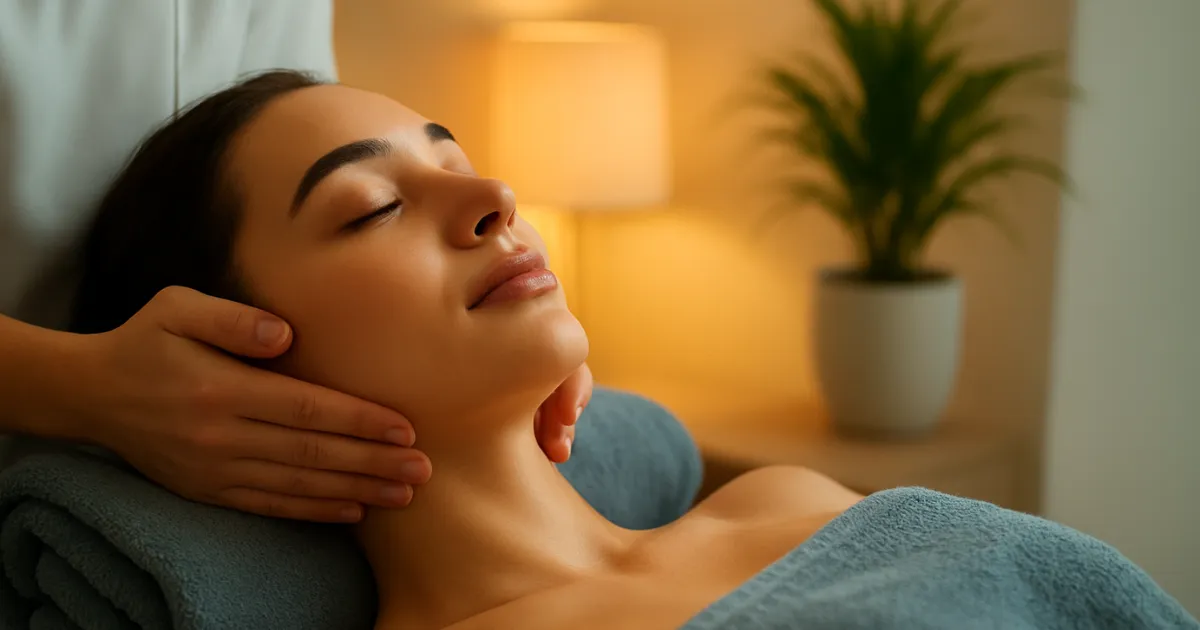
When I begin a facial, I use a technique called effleurage. The word comes from the French, meaning to skim or to touch lightly. In practice, it refers to the long, slow, gliding strokes applied across the face, neck, and décolletage that form the foundation of almost every step that follows.
Effleurage feels relaxing, and it is. But the purpose goes well beyond comfort. These strokes follow the pathways of your lymphatic system, warming the skin, stimulating circulation, and beginning the process of moving lymphatic fluid through the nodes in your face and neck. They also send an early signal to your nervous system that it is safe to slow down, which becomes very important as the appointment continues.
When performed correctly, effleurage:
Warms the skin and prepares it to absorb serums and treatment products more effectively
Increases blood flow to the surface, contributing to that post-facial glow most clients notice immediately
Initiates lymphatic drainage through the nodes in the face and neck
Begins calming the nervous system before any other treatment is applied
That nervous system piece matters more than most people expect. We will come back to it shortly.
Your Lymphatic System and Why It Cannot Work Alone
Your lymphatic system is one of the body's most important detox pathways, and one of the least understood. It is a network of vessels, tissues, and nodes distributed throughout your entire body. Its job is to collect toxins, waste, and excess fluid from your tissues and return them to your bloodstream to be filtered and eliminated.
The catch is that your lymphatic system has no pump. Your heart moves blood automatically. Lymph fluid, by contrast, depends almost entirely on muscle movement and manual stimulation to keep circulating. When you are sedentary, stressed, or dehydrated, that fluid can slow down and pool in the tissues. Your face is often one of the first places this shows up, as puffiness, dullness, congestion, or a lack of definition along the jawline.
During a facial, I focus a significant portion of my work on the neck and jawline, because that is where several major clusters of lymph nodes are located. The cervical nodes run along each side of the neck, and the submandibular nodes sit along the underside of the jaw. By applying effleurage along these specific pathways, I am manually moving lymph fluid in a way your body cannot reliably do on its own.
What lymphatic drainage during a facial actually accomplishes:
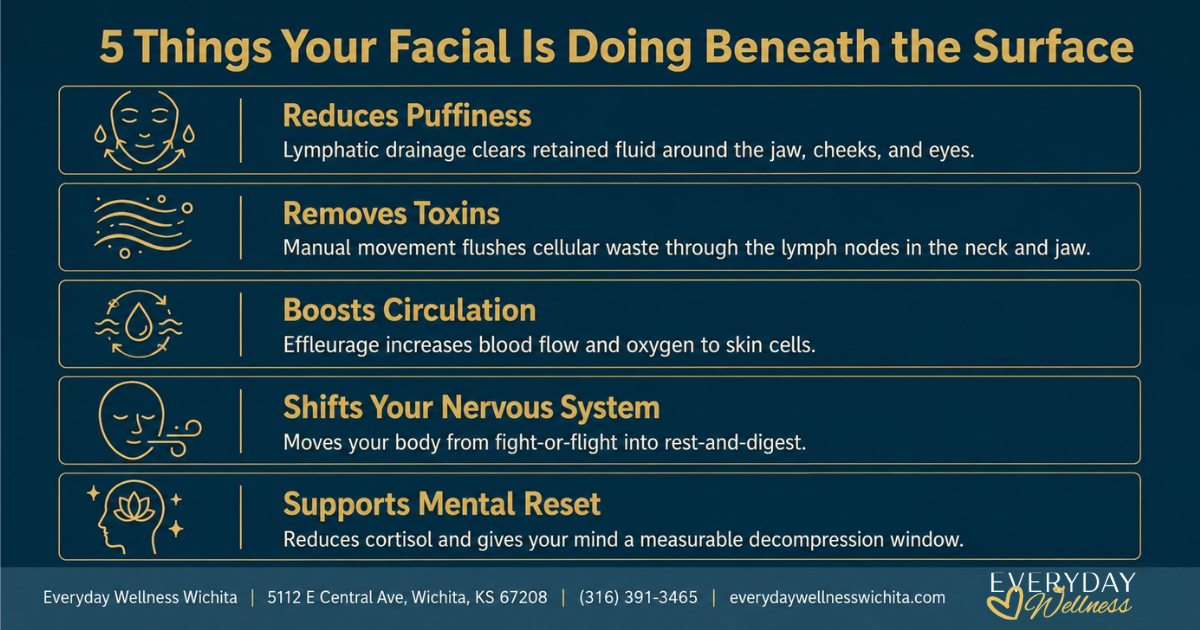
Reduces puffiness around the eyes, cheeks, and jaw by clearing retained fluid
Flushes accumulated toxins and cellular waste from the skin
Enhances the natural definition of your facial contour
Boosts circulation so skin cells receive more oxygen and nutrients
Supports immune function by keeping lymph fluid moving efficiently
I personally deal with chronic sinus issues, and I can tell you from experience that consistent lymphatic work around the neck and jaw makes a genuine difference in how I breathe and how I feel day to day. It is one of the reasons I prioritize this part of every facial, regardless of what else a client's skin needs.
Your lymph nodes exist throughout your entire body, not just in your face and neck. But the face and neck are among the most concentrated areas, and they absorb the most daily exposure from skincare products, environmental pollutants, and stress. Working here creates a ripple effect that benefits the whole system.
Fight-or-Flight vs. Rest-and-Digest: The Nervous System Shift
This is the part of the facial conversation that surprises most people.
Your nervous system has two primary operating modes. The first is fight-or-flight, driven by your sympathetic nervous system. When you are under stress, whether from a work deadline, a difficult conversation, or the general pressure of a busy life, your body activates this mode. Heart rate climbs. Cortisol releases. Your body redirects its resources toward immediate survival and puts lower-priority functions, including skin repair, digestion, and immune response, on hold.
The second mode is rest-and-digest, driven by your parasympathetic nervous system. This is the state where your body does its maintenance work. Cortisol drops. Breathing slows and deepens. Cell repair and regeneration happen here. Your immune system catches up. Your skin rebuilds its barrier. This is the state your body is designed to return to regularly, and for most people, it does not get nearly enough time there.
The reality for most of us is that we spend the majority of our days in some degree of fight-or-flight. Work, family, finances, screens, and the relentless pace of daily life keep our nervous systems in a low-grade state of alert. We rarely fully downshift. And our skin reflects that over time, through inflammation, breakouts, sensitivity, and accelerated aging.
A facial creates a genuine shift.
When you are lying in a warm, quiet room and I am working slow effleurage strokes across your face and neck, your nervous system begins to receive a very clear message: you are safe. You do not need to stay alert right now. You can let go. Research on massage therapy consistently shows that therapeutic touch lowers cortisol, reduces heart rate, and activates the parasympathetic nervous system. Facial massage works through the same pathways. The face contains a high concentration of nerve endings, and gentle, rhythmic stimulation sends calming signals directly to the brain.
Here is what that shift does for your skin:
Cortisol drops, which reduce stress-driven inflammation and decrease breakout activity
Blood flow to the skin increases, supporting cell turnover and repair
Your body processes and clears toxins more efficiently
Deeper breathing delivers more oxygen to skin cells
Retained fluid releases around the face and jaw, reducing puffiness
Your skin glows because it is finally receiving the resources it needs
This is why so many clients tell me they sleep better the night after a facial. It is not a coincidence. Their nervous system spent 60 minutes in rest-and-digest, and that carries forward into the rest of their day and into the quality of their sleep that night.

The Mental Reset Is Just as Real as the Physical One
I want to spend a moment on something that comes up in nearly every client relationship I have, because it matters and it does not get talked about enough.
For many of the people who come to see me, the 60 minutes in the treatment room is the only uninterrupted time they have for themselves in an entire day. Not the only time they do something nice for themselves. The only time they fully stop. No notifications. No one needs something from them. Just quiet, warmth, and permission to breathe.
That is not a small thing. That is a physiological necessity that most of us are chronically missing.
Chronic stress is one of the most significant and underappreciated contributors to skin problems. Elevated cortisol disrupts the skin barrier, increases sebum production, slows wound healing, and triggers inflammatory responses that show up as redness, sensitivity, and premature aging. When the nervous system never fully rests, the skin never fully recovers.
Getting your nervous system into rest-and-digest mode, even for one hour every four weeks, gives your skin a meaningful window to reset. And it gives your mind one too.
Clients regularly describe leaving a facial feeling clearer, calmer, and more capable of handling whatever comes next. That is not a placebo. That is what happens when your brain finally has the space to process and release accumulated stress rather than simply accumulating more of it.
I am a licensed esthetician, not a therapist, and I want to be clear about that distinction. But I work with people every day, and I see the difference that consistent, intentional rest makes for both their skin and their overall sense of well-being. It is one of the most meaningful parts of my work.
Why the Neck and Jawline Are the Priority
Most people assume a facial is focused entirely on the face. And while the face is certainly the main event, some of the most impactful work I do happens in the neck and along the jawline.
Here is why those areas matter so much.
Your neck houses several of the most significant lymph node clusters in the upper body. The cervical lymph nodes run along both sides of the neck, and the submandibular nodes sit beneath the jaw. When these nodes are draining well, your face benefits directly. Fluid moves. Toxins clear. Inflammation settles.
Think about what happens when you are sick. Your lymph nodes swell. That is your immune system working hard to clear a threat. On a smaller, daily scale, those same nodes are managing the ongoing load of environmental exposure, cellular waste, and stress that your skin accumulates over time. Keeping them clear is not optional. It is part of maintaining healthy skin.
By concentrating effleurage work on the neck and jawline during a facial, I am targeting these drainage pathways directly. Clients consistently notice:
Reduced puffiness around the lower face and under the eyes
Clearer definition along the jawline
Some relief from sinus pressure and congestion
A sense of physical lightness in the face that is hard to describe until you have experienced it
For clients who deal with chronic tension headaches, frequent sinus issues, or persistent under-eye puffiness, regular facial appointments are not a luxury. They are a practical part of managing those symptoms.
Why Every Four Weeks Is the Right Interval
One of the most common questions I get is how often someone should come in for a facial. The answer depends on your skin and your goals, but the standard benchmark I work from is every four weeks.
That timing is not arbitrary. Your skin operates on a natural cell turnover cycle of approximately 28 days. That is how long it takes for new skin cells to form, migrate to the surface, and shed. When we support that cycle consistently with lymphatic drainage, deep cleansing, and nervous system reset, we are working in sync with your skin's own rhythm rather than against it.
Over time, regular appointments produce results that a single visit simply cannot:
Your lymphatic system becomes more efficient at draining between sessions
Baseline toxin accumulation in the skin decreases
Chronic skin inflammation gradually reduces
Your nervous system gets regular, scheduled opportunities to reset
Skin tone, texture, and radiance improve cumulatively rather than temporarily
Clients who come in consistently tend to see steady, building improvements. Clients who come in once or twice a year often feel like they are starting from scratch each time, because in some ways they are.
This is also why I ask about your life during our consultation, not just your skincare routine. Your stress levels, your sleep quality, your hormonal picture, and what is happening in your body all show up in your skin. A facial works best when it is part of a broader approach to wellness, not an isolated event.
The Everyday Wellness Difference
What I have described in this post is not standard in most skincare settings. Many esthetics services offer 60 minutes of pleasant treatments and a sample bag on the way out. There is nothing wrong with that, but it is not the approach we take here.
At Everyday Wellness, esthetics is integrated into a whole-body wellness philosophy built by Jen Gaudet, our nurse practitioner and practice founder. Jen's approach is grounded in the belief that external results come from internal health. When I joined this team, it was because her philosophy matched what I had already come to believe through my own experience with my skin.
What shows up on your face is almost always connected to something happening inside your body. Hormones. Gut health. Stress load. Sleep quality. Inflammation levels. A great facial addresses the external side of that equation. And when there are internal drivers keeping your skin stuck, Jen's work addresses those. Together, that is what inside-out care actually looks like.
Frequently Asked Questions
1. Is a facial just for relaxation, or does it have real health benefits?
Both, and they are not actually separate. The relaxation you feel during a facial is your nervous system shifting into rest-and-digest mode. That shift has measurable effects on cortisol, inflammation, and skin repair. Relaxation is a health benefit.
2. How does lymphatic drainage during a facial work?
I use effleurage, a series of slow, deliberate strokes, to manually move lymph fluid through the nodes in your face, neck, and jawline. Your lymphatic system does not have a pump of its own, so it depends on external movement to stay circulating. That is what the massage is doing.
3. How often should I come in?
Every four weeks is the standard benchmark, and it aligns with your skin's natural cell turnover cycle. That said, I will give you a specific recommendation based on your skin type, concerns, and lifestyle during your first appointment.
4. Can a facial actually help with puffiness or sinus pressure?
Yes, and this surprises a lot of clients. Focused lymphatic work around the neck and jawline directly targets the nodes that drain the face. Many clients notice reduced puffiness, clearer jawline definition, and even some relief from sinus congestion after a session.
5. How is a facial at Everyday Wellness different from one at a spa?
The biggest difference is the philosophy. We treat your skin as part of your overall health, not as a standalone concern. That means I am asking about your stress, your sleep, your hormones, and what else is going on in your body, not just your current cleanser. The treatment decisions follow from that conversation.
6. I have never had a professional facial. What should I expect?
Your first appointment begins with a consultation where I learn about your skin history, concerns, and goals. The facial itself typically includes cleansing, steam, exfoliation, extractions if appropriate, massage, a mask, and finishing products. The entire experience is designed to be comfortable and calming. You should leave feeling noticeably better than when you arrived.
7. Is this suitable for sensitive skin?
Yes. Every facial I do is adjusted to your skin's current condition. If you are dealing with sensitivity, redness, or a compromised skin barrier, we work with that reality, not against it. I will never push your skin further than it is ready to go.
If you want to dive in deeper, please take a look at our previous posts in this series:
Episode 1: Healthy Skin Starts on the Inside
Episode 2: What Does Acne Placement Actually Mean
Ready to experience what a facial can actually do for your skin and your nervous system? Let's talk.
Book with Kenzie: https://edw.glossgenius.com/services
Call us: (316) 391-3465
Services: Bio-Identical Hormone Replacement Therapy (BHRT), Medical Weight Loss, Hair Restoration, Allergy Management, Esthetics
Location: 5112 E Central Ave, Wichita, KS 67208
Homepage: https://everydaywellnesswichita.com