

Steroid Shots vs. Allergy Drops: What Your Doctor May Not Be Telling You
I have a story I want to tell you. It is not a comfortable one. It's one of the most important things I can share about why I practice the way I do.
Before I opened Everyday Wellness, I worked at a clinic that offered allergy services. Part of my job was giving injections. Over time, I started noticing a pattern that genuinely bothered me. Patients would walk up and say things like, "I need my summer allergy shot" or "I am here for my yearly allergy shot."
At first, I was confused. That is not how allergy immunotherapy works. You do not get one shot a season. You do not get one shot a year. And then it clicked.
They were not talking about immunotherapy at all. They were talking about steroid injections.
Key Takeaways
Steroid injections and allergy immunotherapy shots are two completely different things. One suppresses your symptoms. The other trains your immune system.
Annual or seasonal steroid injections taken over multiple years can cause serious long-term side effects, including brittle bones.
Many patients receiving these injections had no idea about the risks because nobody told them.
SLIT sublingual immunotherapy is Jen's answer to root-cause allergy care: address the actual problem, not just the symptoms.
Everyday Wellness offers a free phone consultation for anyone curious about whether SLIT is the right fit.
This is the final post in a four-part series on SLIT sublingual immunotherapy, and if any of what I share here lands hard or raises questions for you, the earlier posts in this series will help fill in the picture.
I started the series with Why Your Allergy Medication Is Not Solving the Real Problem, where I explain why over-the-counter medications keep so many people stuck in the same cycle year after year. From there, I walked through SLIT vs. Allergy Shots: What Busy Families Need to Know, comparing the two main root-cause treatment options so you can see how they actually work and which one fits the realities of a packed schedule. And just before this one, I covered Who Is Actually a Good Candidate for SLIT Allergy Drops?, which helps you figure out whether this approach is the right fit for your situation.
If you have not read those yet, they are a good companion to what I am about to share.
The Shot That Was Not What They Thought It Was
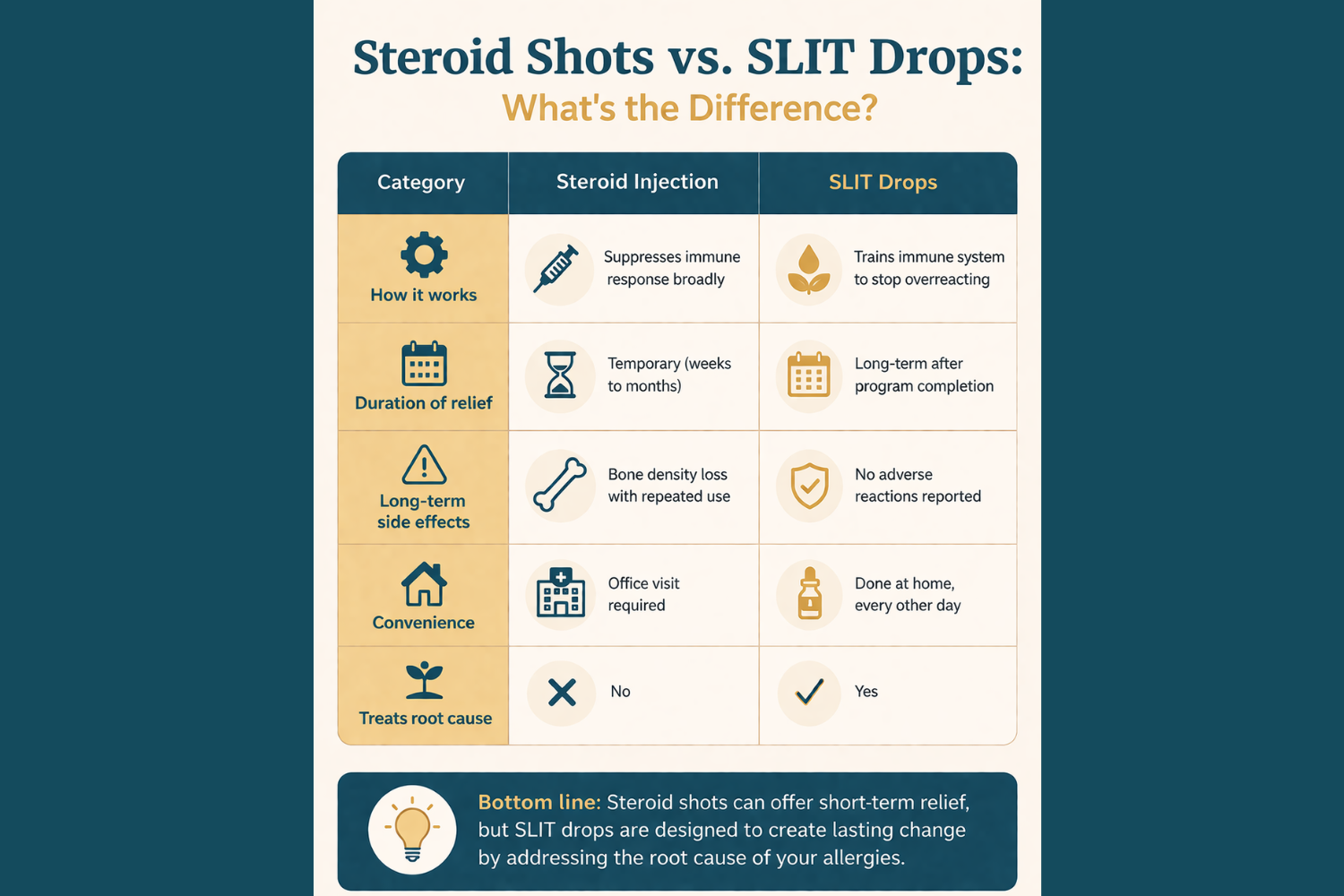
A steroid injection is not an allergy immunotherapy. It is a systemic, long-acting anti-inflammatory. When you receive it, your immune system is broadly suppressed. Inflammation goes down. Symptoms go away. You feel better.
And I understand why that is appealing. When you are miserable in the middle of allergy season, you want relief fast. A steroid injection delivers that. I am not pretending otherwise.
But here is what was not being explained to patients at that clinic, and what I suspect is not being explained to patients at a lot of places: if you get one, two, three, or four of those injections per year, you are essentially living with chronic steroid exposure. Year after year, season after season.
And that has consequences.
What Chronic Steroid Use Actually Does to Your Body
Long-term steroid use affects bone density. This is well established in medical literature. Steroids interfere with the way your body absorbs calcium and maintains bone mass. Over time, repeated steroid injections can contribute to a condition called osteoporosis, where bones become brittle and fracture more easily.
I would look at patients in their 30s and 40s getting these shots and think: they feel great right now. But in 20 years, when they are dealing with a broken hip or a compression fracture, they are going to trace it back to this. And nobody is connecting those dots for them today.
I would tell patients directly. I would explain the risks. Some of them would say, "I do not care, I want the shot." That is their right. They weighed the pros and cons with full information and made a decision. I respect that.
But a lot of them had absolutely no idea. They would look at me like I was speaking another language. And when I laid it out clearly, they would ask the obvious next question: "Okay, so what else can we do?"
What I Was Searching For
At that time, I could refer patients to an allergist or an ENT for traditional allergy immunotherapy shots. That is the legitimate root-cause option, and it works. I have gone through the program myself, and my allergies are almost completely resolved. It is effective.
But I also knew firsthand how hard it is to complete. Weekly office visits for three to five years. Sitting for 30 minutes after each shot. A rotating schedule that has no flexibility. When I was in graduate school with young children and a full-time job, I could barely finish the program, even with the privilege of being able to do my shots at home.
Most people cannot do that. Their schedules will not allow it. Their lives will not allow it.
So I kept asking: is there another way to get patients to the same destination without the barrier of weekly office visits and injections?

Why SLIT Became the Answer
When I started researching options for Everyday Wellness, I found sublingual immunotherapy. The same principle as allergy shots. The same goal: train your immune system to stop overreacting to the things it has incorrectly identified as threats. But delivered as drops under the tongue, done at home, every other day.
No needles. No office visits every week. A program that patients could actually complete.
The company I partner with to formulate these serums has an outstanding safety record. Zero adverse reactions reported. That is not a claim I repeat lightly. When I recommend something to my patients, I have to be able to stand behind it the way I would if I were recommending it to my own family. SLIT meets that standard.
And more than the convenience or the safety profile, SLIT aligns with the philosophy I built this practice around. We do not put Band-Aids on problems here. We find the root cause, and we address it.
Steroid injections suppress inflammation temporarily. Antihistamines block histamine temporarily. They are not bad tools in an emergency. But they are not treatment. They are management.
SLIT is a treatment. It works with your immune system, teaches it what is actually a threat and what is not, and gives it the tools to stop overreacting. When the program is complete, most patients see results that last. Not just for this season. Long term.
What I Want You to Know Before You Call
If you have been getting seasonal steroid injections and this is the first time someone has told you about the long-term risks, I am not trying to scare you. I am trying to give you the information you deserve so you can make a decision that is right for you.
And if you have been managing your allergies year after year with antihistamines and nasal sprays and you are tired of it, I want you to know there is another option worth exploring.
We offer a free phone consultation for anyone curious about SLIT. No pressure. No commitment. Just a conversation to answer your questions and help you figure out if this is the right fit for your situation.
Spring is already here in Kansas. It is not too late to get started. And if you start now, you will be ahead of it by this time next year.
Ready to stop managing and start treating? Let's talk.
Book your free phone consultation by clicking here or call us directly: (316) 391-3465
This article is for educational purposes only and does not constitute medical advice. Please consult a qualified healthcare provider before starting any new treatment program.