

Who Is Actually a Good Candidate for SLIT Allergy Drops?
If you have been wondering whether SLIT allergy drops might be right for you, you are asking exactly the right question.
Most people hear about SLIT and immediately want to know two things: does it actually work, and am I the kind of person it works for? Those are smart questions. And the honest answer to both of them is worth understanding before you make any decisions.
I have covered why antihistamines often fall short of actually solving the allergy problem in Why Your Allergy Medication Is Not Solving the Real Problem, and I have walked through how SLIT compares to traditional allergy shots in SLIT vs Allergy Shots: What Busy Families Need to Know. This week, I want to answer the more personal version of the question: Is this actually for someone like me?
Key Takeaways
SLIT allergy drops are designed to address the root cause of environmental allergies, not just manage symptoms.
Good candidates include adults, children four and up, busy people who cannot commit to weekly office visits, and anyone struggling with antihistamine side effects.
The process is simpler than most people expect: one finger stick, a custom serum, and drops done at home every other day.
Most patients notice real improvement in the first four to eight weeks, with long-lasting results after completing the full program.
Let me be direct with you. SLIT is not a niche treatment for a narrow group of people. If you live in Kansas and you have seasonal or environmental allergies, there is a good chance this conversation applies to you.
Why Kansas Makes This Conversation So Relevant
Before I get into the specific candidate profile, I want to give you a little context about why this matters so much here.
Kansas is consistently ranked among the top five worst states in the country for seasonal allergy sufferers. That is not just a talking point. It reflects the reality of living on flat, open land with very little elevation, a lot of wind, and a long list of environmental triggers that overlap across seasons.
We have tree pollen in the spring. Grass pollen in late spring and early summer. Weed pollen and mold in late summer and fall. Dust mites year-round. And because our seasons tend to bleed into one another, some of my patients are symptomatic for the better part of the year. There is not much downtime between triggers.
We also have limited allergist access in Wichita. There is one allergist in town. ENTs have helped fill that gap, and most conventional options available locally involve weekly office visits for years. That structure simply is not realistic for everyone.
That is part of why I brought SLIT into Everyday Wellness. Not as a lesser option, but as a treatment that makes root-cause allergy care actually completable for real people living real lives.

Who Is a Good Candidate for SLIT?
The straightforward answer is that most people have seasonal or environmental allergies. But I want to be specific, because I think the details matter.
You are likely a good candidate if your allergies show up every year.
Trees, grass, mold, ragweed, dust mites. If any of those reliably disrupt your quality of life season after season, that is a sign your immune system has learned to treat those substances as threats. SLIT is designed to address that pattern over time, not just quiet the reaction temporarily.
You are likely a good candidate if you are tired of taking daily antihistamines.
Zyrtec, Claritin, Allegra, Xyzal. These medications do what they are designed to do: they block histamine receptors and reduce your body's ability to respond to the allergen signal. That helps. But the moment you stop taking them, the reaction comes right back because nothing about your immune system's behavior has changed. If you have been on daily allergy medication for years and you are ready to ask whether there is a longer-term answer, SLIT is worth understanding.
You are likely a good candidate if antihistamines are causing their own problems.
Antihistamines are drying medications. For some patients, that is manageable. For others, it creates a real secondary problem. I have patients who get chronically constipated. I have patients who cannot tolerate antihistamines at all because of urinary sensitivity. I have patients who feel foggy or oddly flat on antihistamines. If the medication meant to help you is creating its own set of symptoms, that is a meaningful sign that this approach is not a sustainable fit for your body.
You are likely a good candidate if your schedule makes weekly office visits unrealistic.
This is one of the most practical points I make with patients. Traditional allergy shots, which are called subcutaneous immunotherapy, are highly effective. I went through that program myself, and my allergies are nearly resolved as a result. But the structure requires a weekly office visit, a 30-minute wait to confirm you are not having a reaction, and then doing it all again the following week. For three to five years.
I know firsthand how hard that is to sustain. I was in graduate school, working full-time, and raising young children when I went through the program. I could only finish it because, as a provider, I was allowed to do my shots at home. That is not an option most patients have. SLIT drops are done at home by design. Every other day, under your tongue, on your schedule. You travel with them. You build them into your morning routine. You do not have to rearrange your life to stay consistent with your treatment.
You are likely a good candidate if you have a child four years or older with environmental allergies.
This one matters to me personally. I used to administer allergy shots to children as young as four at a previous clinic. Two or three injections at a time. And I would watch these kids dread every appointment. You could see it in their faces walking through the door. That kind of weekly stress on a child is real, and it has effects beyond just the appointment itself.
SLIT removes all of that. No needles. No waiting room. Just drops under the tongue at home, done in seconds. For children, especially, this can change the entire experience of getting allergy treatment.
You are likely a good candidate if you are still having breakthrough symptoms on medication.
If you are already taking a daily antihistamine and still having bad days, still dealing with itchy eyes or sinus pressure or postnasal drip, that is important information. It means your immune response is stronger than your medication can fully contain. That is not a failure. It just means symptom management alone is not enough for your situation. Your immune system needs more than being blocked. It needs to be retrained.

What SLIT Is Not For
I want to be honest here, because I think honesty is part of what makes a good care relationship work.
At Everyday Wellness, we offer SLIT for environmental and seasonal allergies. We do not offer SLIT drops for food allergies.
That is an intentional decision, not an oversight. Food allergies carry a very different level of risk than environmental allergies. A ragweed allergy is uncomfortable and disruptive. A peanut allergy can be life-threatening. I am a family nurse practitioner, not an allergist. We are a small practice, and I am not set up to safely manage the monitoring and intervention protocols that food allergy treatment can require.
If food allergies are part of your picture and you are interested in whether immunotherapy might help with those, I would encourage you to pursue that conversation with an allergist. That technology does exist. I would just rather point you in the right direction than offer something that falls outside what I can safely deliver here.
For environmental allergies, we are the right conversation to have.
How SLIT Actually Works
I want to take a moment to explain the mechanism in plain terms, because I find that people are more committed to treatment when they understand what is actually happening.
When you have environmental allergies, your immune system has made a mistake. It has identified something harmless, like tree pollen, dust mites, or cat dander, as a threat. Every time you encounter that substance, your immune system responds as if it needs to fight something off. It releases histamine. You get the familiar cascade of symptoms.
SLIT introduces small, controlled amounts of the exact allergens your body reacts to directly under the tongue. The tissue under the tongue has a unique relationship with the immune system. It is what is called a tolerogenic environment, meaning it is particularly well-suited to training the immune system to calm down rather than escalate. Over time, with repeated exposure to these microdoses, your immune system stops treating those allergens as threats.
The doses are small enough that you should not experience a significant histamine reaction. You are not triggering the problem. You are very gently and repeatedly signaling your immune system toward a different response.
This is the same fundamental principle as allergy shots. The mechanism is identical. The difference is the delivery method and the fact that you do it at home.
What Realistic Results Look Like
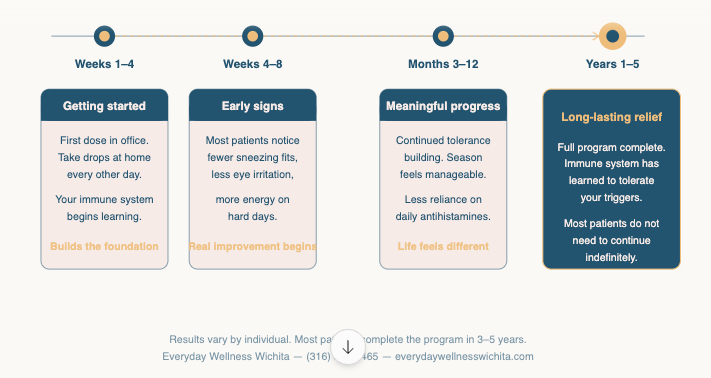
I am not going to tell you this works overnight, because it does not. Anything that works overnight for allergies is managing the reaction, not changing it.
Here is what most of my patients actually experience.
In the first four to eight weeks, most people notice some improvement. It might be fewer sneezing fits. Less eye irritation. A little more energy on days that would have been difficult before. The changes are gradual, which can feel slow, but the direction is consistent.
Timing matters too. If you have spring allergies and you start in winter, you are setting yourself up well. The drops should be building immune tolerance right as pollen season begins. If you are allergic to multiple seasons, which is very common in Kansas, we start whenever you are ready, and you will typically see meaningful improvement within the first quarter.
The full program runs three to five years for most people. That is the same timeline as allergy shots. But the difference is that you are doing it at home, on your schedule, without carving out weekly appointments. That changes how sustainable the program feels over a long period of time.
The goal by the end of the program is long-lasting relief. Not continued management forever. Not "stay on this indefinitely." The idea is that your immune system has learned enough to handle these triggers on its own, and most people do not need to continue indefinitely after completing the program.
What Your First Appointment Actually Looks Like
I find that some people hesitate because they are not sure what they are walking into. So let me walk you through it.
When you come in for the first time, we sit down and go through your history. What are your symptoms, when do they tend to hit hardest, what have you already tried, what has helped, and what has not? That conversation gives me the context I actually need to make good decisions for your care.
Then we do the allergy testing. And here is the part that surprises people, especially parents bringing kids in.
We use a finger stick, not a full blood draw. We poke the tip of your finger, collect five small drops of blood on a card, put a bandage on, and we are done. The kids survive it. The adults survive it. We send that sample off to the lab and find out exactly what your immune system is reacting to.
Once your results are back, I will order your custom serum. This is not a one-size-fits-all formula. It is built around your specific allergens, your specific test results. Then we schedule your return visit.
You come in, I administer your first dose in the office, and assuming you tolerate it well, which you will, you go home with your drops. The next time I see you is three months later, when you are ready for your next concentration level. In your first year, I see most patients four or five times. After that, annually, unless something comes up.
That is it. Compare that to weekly office visits and 30-minute post-injection waits. The practical difference is significant.
Common Questions I Hear
1. Does it hurt?
Aside from the finger stick, which takes one or two seconds, no. The drops themselves are placed under the tongue and cause no discomfort.
2. Is it safe?
The company I work with to prepare our serums has reported zero adverse reactions. That is not a small thing. It is an exceptional safety profile for any medical treatment.
3. How long is the program?
Three to five years for most patients, the same as allergy shots. But you are doing it at home, not in a waiting room, which changes the experience substantially.
4. Is it covered by insurance?
No. Insurance covers subcutaneous allergy shots, not sublingual drops. That is a real financial consideration, and I do not minimize it.
But I also think it is worth doing the honest math. How much are you currently spending on antihistamines, nasal sprays, and urgent care visits for sinus infections? How much does a bad allergy week cost you in lost productivity or missed plans? SLIT is an upfront investment to fix the problem, not funding it indefinitely. For many patients, when they look at the full picture, it is less daunting than it initially seemed.
5. What if I am allergic to many things?
That is actually common here in Kansas. Your serum is built from your specific lab results. The more precisely we know what you are reacting to, the more precisely we can build the treatment. Being allergic to a lot of things does not disqualify you. It just means we need that testing so we know what we are working with.
Is This the Right Time to Start?
Spring is here or very nearly here. And for anyone with spring allergies, now is genuinely a practical time to begin the conversation.
The sooner we can get your allergy testing done, the sooner we can get your custom serum ordered and your drops in your hands. If you start now, you can be building immune tolerance during a season when your immune system is already being exposed to your triggers, which is exactly the environment this treatment is designed for.
If you are allergic to multiple seasons, starting now means you should see meaningful improvement well before the worst of summer or fall arrives.
If you want to talk through whether this makes sense for you before committing to anything, we offer a free phone consultation. It is just a conversation. No pressure and no obligation.
Ready to stop managing your allergies season after season and ask whether there is a more complete answer? Call us, visit the website, or send us a message. Let us figure out together whether SLIT is the right next step for you.
Call (316) 391-3465, visit https://everydaywellnesswichita.com/contact, or email [email protected] to get started.
You do not have to keep white-knuckling it through every allergy season. There may be a better path, and it starts with knowing what your body is actually reacting to.
This article is for educational purposes only and is not a substitute for medical advice, diagnosis, or treatment. Please consult your qualified healthcare professional before making any changes to your care.