

SLIT vs Allergy Shots: What Busy Families Need to Know
If you are a busy parent, a working adult, or someone already trying to manage a full life, allergy treatment cannot just sound good in theory. It has to work in real life, too. That is where this conversation becomes so important.
Many people know they have allergies, but they do not always realize how much those allergies are affecting their everyday life. They may be dealing with congestion, sinus pressure, itchy eyes, postnasal drip, fatigue, poor sleep, or brain fog. They may feel off for weeks or months at a time and assume that is just normal for the season. Often, they are already taking something for symptoms and trying to push through. At some point, though, many people start wondering whether there is a better long-term answer. If that sounds familiar, you may also want to read Why Your Allergies Keep Coming Back No Matter What You Take where Jennifer explains why symptom relief is not always the same as actually treating the problem.
That is usually when immunotherapy enters the conversation.
Key Takeaways
Both allergy shots and SLIT are forms of immunotherapy. They share the same goal: helping your immune system become less reactive over time.
The biggest difference is not effectiveness. It is how well each option fits into your real life.
For busy parents, working adults, and families with kids who dislike injections, SLIT may be easier to stay consistent with because it is done at home.
Consistency drives results. The best treatment is the one you can actually stick with.
Once people begin comparing options, things can get confusing quickly. They hear that allergy shots work. They hear about SLIT allergy drops. They hear words like effective, convenient, long-term, customized, and root-cause. Then they are left trying to sort out what all of that actually means for their body, their family, and their schedule. That is why this topic matters so much. The best allergy treatment is not simply the one that sounds most impressive on paper. It is the one that makes sense for your symptoms, your life, and your ability to stay consistent over time.
Watch: SLIT vs Allergy Shots: What Busy Families Need to Know
This is one reason Jennifer’s perspective is so valuable. Allergy shots worked for her, and she knows they can be effective. At the same time, she also knows firsthand how difficult they can be to complete during a demanding season of life. When she was working full-time, in school, and raising young children, keeping up with that type of treatment was hard. That personal experience shapes how she talks with patients now. She understands that a treatment can be both helpful and difficult to sustain. That is the heart of this conversation.
What allergy shots are
Allergy shots are one of the most established forms of allergy immunotherapy. Unlike medications that temporarily calm symptoms, allergy shots are designed to help retrain the immune system over time so it becomes less reactive to specific allergens. In other words, the goal is not just to make you feel a little better today. The goal is to reduce the body’s overreaction in a more lasting way.
That sounds straightforward, but the actual process can be more demanding than many people expect. Treatment usually begins after allergy testing identifies the substances triggering symptoms. From there, the patient follows a structured plan that gradually introduces those allergens in carefully controlled amounts. Over time, the immune system is supposed to become less reactive.
For many people, the challenge is not understanding why allergy shots can help. The challenge is the structure of the treatment itself. It often involves repeated office visits over a long period of time. Even when people are motivated, those visits require transportation, schedule coordination, waiting, and follow-through over months and sometimes years. That can be manageable for some people, but for others it becomes a serious obstacle.
This matters because real life is rarely simple. Parents are juggling school schedules, work responsibilities, sports, errands, childcare, and everything else that comes with running a household. Working adults may have demanding jobs, unpredictable hours, or long commutes. So when someone says, “I know allergy shots can work, but I do not know how I would keep up with that,” they are not being lazy. They are being realistic.
What SLIT is
SLIT stands for sublingual immunotherapy. Sublingual means under the tongue. Like allergy shots, SLIT is a form of immunotherapy, which means it is intended to address the allergic response more deeply rather than only covering symptoms for a few hours at a time.
That distinction is important because some people hear about SLIT and assume it is a lighter or less serious version of treatment. That is not the right way to think about it. SLIT is still immunotherapy. It is still designed to help the immune system become less reactive over time. The biggest difference is not the purpose of the treatment. The biggest difference is how the treatment is delivered and how that delivery fits into everyday life.
In Jennifer’s clinic model, patients begin with allergy testing and then receive a customized treatment plan based on their environmental triggers. The first dose is done in the office, and then treatment continues at home. That changes the day-to-day reality in a meaningful way. Instead of organizing life around repeated injections and office visits, the treatment becomes something that can be incorporated into a regular home routine.
For many families, that difference matters a lot. It matters to the parent trying to get everyone out the door in the morning. It matters to the adult whose workdays never seem to end on time. It matters to the family that is already stretched thin by school, sports, travel, work, and everything else life brings. It is not just about convenience in a superficial sense. It is about whether a treatment can actually be maintained.
How are they similar?
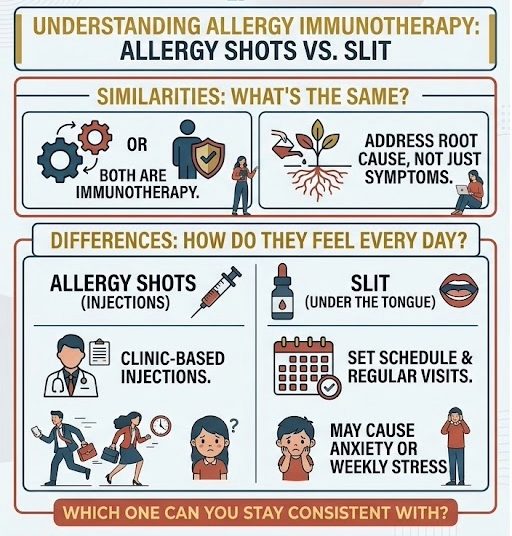
One of the most important things to understand is that allergy shots and SLIT are more alike than they are different in purpose. Both are forms of immunotherapy. Both are designed to address the immune system’s response to allergens rather than just suppressing symptoms temporarily. Both are meant to be longer-term strategies. And both require consistency.
That last point is especially important. Neither allergy shots nor SLIT is an instant fix. They are not like taking a medication in the morning and expecting to feel dramatically better by lunchtime. They require patience, repetition, and follow-through. That is why the best comparison is not simply which one sounds better in theory, but which one a person can realistically stay consistent with over time.
Both options also appeal to people who are tired of only managing symptoms and want to consider a deeper strategy. Patients who are interested in root-cause care are often looking for exactly that. They want to understand why their body is reacting the way it is, and they want options that aim to change the pattern, not just soften it for a few hours.
How are they different?
While the goal of both treatments is similar, the everyday experience can feel very different. That is where the decision often becomes more practical than theoretical.
Allergy shots usually require a series of office-based injections on a set schedule. For some people, that routine is workable. They do not mind the appointments; they can fit them into their week, and they are comfortable staying consistent with that type of structure. For other people, though, the repeated visits quickly become one more burden in a life that is already full.
SLIT changes that rhythm. Instead of requiring regular injections in a clinic setting, it is taken under the tongue at home according to the provider’s plan. That shift can make a big difference. The question becomes less about how to get back to the clinic again this week and more about how to build treatment into a normal home routine.
There is also an emotional side to this decision, especially for parents. When parents think about allergy care, they are not just comparing treatments on a chart. They are thinking about the experience their child will have. Will my child be afraid of repeated injections? Will this become a weekly stress point? Can we realistically keep doing this during the school year, sports season, or a busy family season? Those are not small questions. They are part of what determines whether a treatment is realistic for that family.
Adults ask their own version of the same questions. How does this fit with my work schedule? What happens if I travel? What if I already feel overextended? Can I honestly keep up with this? Those questions are not excuses. They are wise and practical considerations.
Why compliance and convenience matter so much
This is where the conversation often gets more honest. People sometimes feel like convenience should not matter if a treatment is medically sound. They may even feel guilty for considering it. But in real life, convenience is closely tied to compliance, and compliance is closely tied to results.
If something is too time-consuming, too disruptive, or too difficult to coordinate, people are more likely to fall behind. They may postpone appointments, skip steps, or eventually stop altogether. That does not happen because they do not care. It happens because life is full, and healthcare has to fit inside real lives.
That is especially true when a treatment stretches over a long period of time. A plan that feels manageable for two or three weeks may feel very different after several months. What sounds fine in theory can become exhausting in practice. That is why convenience is not a shallow concern. It is part of the clinical reality.
Jennifer’s personal experience helps make that point clear. She knows allergy shots can work because they worked for her. She also knows how difficult they were to complete when she was in a busy season of life. That perspective is deeply helpful because it permits patients to be honest. You do not have to pretend your schedule does not matter. It does matter. A treatment that constantly fights against your life is harder to sustain than one that fits into it.
Why this especially matters for parents and busy families
Families do not experience healthcare one person at a time. They experience it as a system. If one child needs repeated appointments, the whole family usually feels the impact. Someone has to handle transportation. Someone has to manage siblings. Someone has to adjust work schedules. Someone has to absorb the emotional strain if the child begins to dread the process.
That is one reason this conversation matters so much for families with children. Parents are not only thinking about effectiveness. They are thinking about what treatment looks like in the flow of everyday life. They are thinking about school drop-off, after-school activities, work schedules, family responsibilities, and the emotional tone of the whole experience.
A treatment can be medically appropriate and still be hard for a family to carry out consistently. That does not mean the family is failing. It means the treatment decision has to take real life into account. For many parents, that is exactly why an at-home option feels worth considering. If something is easier to build into the day, it may be easier to maintain long enough to actually help.
This also matters for children who are anxious about injections. Parents know their own child. They know whether appointments feel manageable or whether they become a weekly struggle. That emotional reality should not be dismissed. It is part of the decision.

My perspective on shots vs. SLIT
The most balanced way to say it is this: allergy shots can be a very good option, and SLIT can also be a very good option. The goal is not to make one sound bad and the other sound superior in every case. The goal is to help patients understand what may be most realistic and most appropriate for them.
Allergy shots have helped many people. They may be an excellent fit for someone who is comfortable with injections, able to make regular office visits, and ready for that level of structure. SLIT may be a better fit for someone who wants a root-cause approach but knows that repeated clinic visits are going to be difficult to sustain.
That is what makes this such a personal decision. Convenience is not about taking the easy way out. It is about recognizing what makes consistency possible. And in long-term care, consistency matters.
If you travel often, work irregular hours, care for children, or already know that weekly appointments are likely to become a burden, that does not make you less serious about treatment. It may simply mean you need a format that fits the realities of your life.
What patients often get wrong about this decision
Many people assume the main question is, “Which treatment is strongest?” But that is not always the most helpful question. A better question is, “Which treatment fits my symptoms, my goals, my tolerance, and my actual life?”
That is a more honest and more useful way to think about it.
Another common misunderstanding is expecting immunotherapy to feel like symptom medication. It does not work that way. Allergy shots and SLIT are not designed to be one-day rescue treatments. They are longer-term strategies that require repetition and patience. That is why patients need to go into the process with realistic expectations.
It is also common for people to assume that if something is more time-intensive, it must automatically be better. That is not always true. Sometimes the better treatment is the one a patient can actually sustain. In real life, that can make all the difference.
How does this fit the Everyday Wellness approach
At Everyday Wellness, the goal is not to shame people for using symptom relief. Sometimes you do need relief. Sometimes you need to function today. There is nothing wrong with wanting to feel better in the moment.
At the same time, symptom relief and root-cause care are not the same thing. That is the deeper conversation here. Jennifer’s approach is about helping patients understand what is driving their symptoms and what options may support longer-term improvement, not just short-term survival.
That is part of what makes this discussion about more than convenience alone. It is about informed decision-making. Patients deserve to understand what they are choosing, why they are choosing it, and whether that plan actually makes sense for their life. A treatment is only useful if it fits both the patient’s health goals and the reality of how they live.
Who may want to ask more questions about SLIT?
SLIT may be worth a closer look if you know weekly shot visits would be hard to sustain, if you have a child who struggles with injections, if you travel often, or if you simply want a treatment option that fits more naturally into home life. It may also be worth discussing if you are interested in a longer-term, root-cause approach, but know that repeated clinic visits are likely to become a barrier.
Allergy shots may be worth discussing more deeply if you prefer a traditional office-based immunotherapy model, feel comfortable with injections, and know that you can realistically keep up with the visit schedule over time. For some patients, that structure works well. The key is not to assume one answer fits everyone.
What I want busy families to remember
You do not have to make this decision from a place of guilt. You do not need to choose the option that sounds hardest just to prove that you are serious. And you do not need to pretend your schedule does not matter.
It does matter.
If a treatment has little chance of fitting into your real life, that matters clinically because it affects follow-through. For many families, the most responsible question is not just whether a treatment can work. It is whether they can stay with it long enough for it to work. That is a very wise question, and it is exactly the kind of question worth asking.
FAQ
Are allergy shots effective?
Yes. Allergy shots can be very effective for many patients and are one of the most established forms of allergy immunotherapy.
Is SLIT the same as allergy shots?
They are similar in purpose because both are forms of immunotherapy, but they are delivered differently. Allergy shots are given by injection in a medical office, while SLIT is taken under the tongue.
Is SLIT easier for busy families?
For many families, it may be. Because it is done at home, SLIT can be easier to fit into a busy routine than repeated office visits.
Are allergy shots bad?
No. This is not about saying allergy shots are bad. They can be a very good option. The issue is whether they are realistic and sustainable for a particular patient or family.
Can children do SLIT?
That depends on the child, their symptoms, and the provider’s clinical approach. It is a conversation worth having if you are looking for an option that may be easier for family life.
How long does immunotherapy take to work?
Immunotherapy is not a quick fix. Both allergy shots and SLIT are longer-term approaches that require consistency and patience over time.
How do I know which option is right for my child or me?
That depends on your symptoms, testing, schedule, preferences, and overall health picture. The best next step is a personalized discussion about what makes the most sense for your situation.
Call to action
If you have been wondering whether allergy shots or SLIT would make more sense for you or your child, you do not have to figure that out alone.
At Everyday Wellness, the goal is to look at the full picture, including your symptoms, your testing, your history, your schedule, and your family reality. From there, you can have an honest conversation about what option is most realistic and most aligned with your goals.
Ready to talk through your allergy options?
Call (316) 391-3465
Schedule your consultation
https://everydaywellnesswichita.com/contact
You do not need a treatment plan that only works in theory. You deserve one that works in real life