
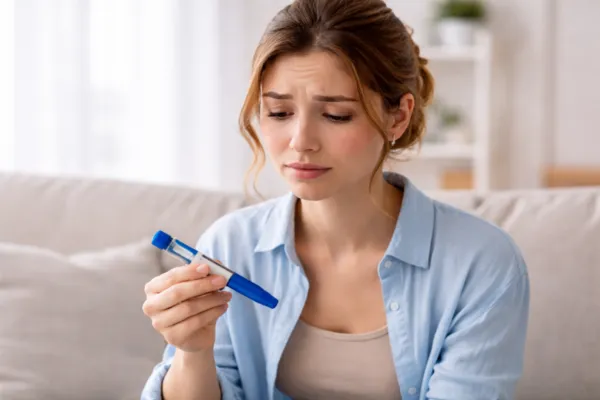
Nervous About Your First GLP-1 Injection? Read This
Let me guess. You finally made the decision to try medical weight loss. You're excited about the possibility of actually losing weight without white-knuckling through another restrictive diet. But then your provider hands you a prescription and says, "You'll inject this yourself at home once a week."
And suddenly, you're spiraling. Wait, what? I have to stick myself with a needle? What if I mess it up? What if it hurts? What if I pass out?
I hear this all the time. And here's what I tell every single one of my weight loss clients: you're not alone, and it's way easier than you think.
I've been doing these injections myself for years. I've taught hundreds of clients. And I promise you after your first shot, you're going to text me and say, "That's it? That was so easy. I didn't even feel it."
But I know you're still nervous. So let's walk through everything and I mean everything so you feel confident, not terrified.
A calm, real-time walkthrough from Jen
Before We Even Talk About Needles
Let's Plan Your First Shot Like a Pro
Here's what most providers don't tell you:
Pick the Right Day
Most of my clients do their first injection on Friday evening or Saturday morning. Why? Because the first 24-48 hours can bring mild nausea or fatigue as your body adjusts. Not everyone gets it, but if you do, you want to be home, relaxed, and not trying to power through a work meeting.
Stock Your Fridge
Before shot day, grab:
Bland proteins (rotisserie chicken, hard-boiled eggs, Greek yogurt)
Crackers or pretzels
Ginger tea or ginger ale
Electrolyte drinks
You might not need any of this. But if you feel a little queasy, you'll be glad it's there.
Get Your Supplies Together
You'll need:
Your vial of medication
Insulin syringes (your pharmacy provides these)
Alcohol swabs
A sharps container (we'll talk about this in a minute it's important)
Take a Breath
Seriously. Anxiety makes your muscles tense, which makes the injection hurt more. So before we start, I want you to remember: this needle is tiny. Like, barely-there tiny. Most of my clients say it feels like less than a mosquito bite.
Ready? Let's do this.
Drawing Up Your Medication (AKA The Part Everyone Overthinks)
Everyone is so anxious about drawing up meds. It's not normal to be playing with needles, right? So I get it. But I've been a nurse for a very long time. I feel like I can do this in my sleep, and I promise you that after a few injections, you will be able to as well.
Here's exactly what to do:
Start with Clean Hands
Always wash your hands first. We're going to assume you've done that.
Clean the Vial
Take your alcohol swab and clean the hub that's the little rubber piece on top of your vial. When you first receive your medication, it's going to have a plastic cap covering it. Just flick that off and toss it in the trash. It doesn't go back on. From now on, you'll always clean that hub with an alcohol swab before drawing up your dose.
Pull Air into the Syringe
I like to pull down the syringe with air the same amount that I want to inject. So let's say we're doing 40 units. Pull the plunger down to the 40 unit mark. We always measure at the top of the black stopper.
Insert the Needle
Pull the cap off your syringe. These needles are very fine the biggest problem I have with them is that they tend to bend easily. So aim for the center of that rubber hub. I like to do a little twist and push down at the same time.
Push Air into the Vial
Push your plunger down and put the air inside of that vial. This creates positive pressure that makes drawing up the medication easier.
Flip It Upside Down
At that point, tip the vial upside down. And I tell everybody flip it upside down. That sucker is not coming out of there. No issues there.
Pull Down More Than You Need
I like to pull down more than what I need. So if I want to do 40 units today, right now I'm sitting at about 70 units. I do that because it helps me get rid of air bubbles.
Get Rid of Air Bubbles
Now, air bubbles are never going to hurt you when we're dealing with a 1 ml syringe. It takes at least 30 mls of air to create an actual air bubble in your bloodstream. And this is going nowhere near your arteries or veins because this is going into your fat layer anyway.
I only tell my clients to be careful of air bubbles because when we start weight loss shots, oftentimes your dose is going to be really small. And if you have a big fat air bubble in there, you're going to rob yourself of half your dose sometimes. That's the only reason why we talk about air bubbles in this setting.
So I'm going to pull down past 40 units, then I like to hold it in one hand and flick it. That way, if there are any air bubbles in there, they're going to all rise to the top. And then I can push them back up into the vial.
Get Your Exact Dose
Now I have my 40 units. That's where I want to be. And then we are ready to go.
Store It Until You're Ready
I tell everybody, leave your syringes in there, and you can just pull them out when you're ready to inject. If you are pre-drawing your syringe and you're not ready to poke yourself you're just getting it ready for later or another day then you're going to recap that guy.
If you are shaky, I would recommend putting the cap down on the table, and then scooping the cap up with the needle. You just never want to put it down on the table with the needle touching the surface. That would make your needle dirty. This needle is going inside your body, so we need to keep it clean at all times.
Where to Actually Poke Yourself
There are three spots that are recommended. Basically, you can inject it anywhere where you're a little fluffy, and you have some fat there. But you're going to go for three sites: around your belly button, under your arm, or on your leg.
The Abdomen (My Favorite Spot)
My favorite spot, especially for GLP-1s, is the abdomen. If you're on a GLP-1 medication, you've got real estate here. So you got fat that we can squeeze in this area.
Find your belly button. You want to go two finger lengths below that or off to the side. This is a great spot for GLP-1s.
I like to go left or right. That way, we can alternate. You should always alternate your injections because if you always hit the same spot over and over and over again, you'll develop a little bit of a callous. So I like to alternate left and right, left and right every week.
The Arm (If You Have Help)
If you want to do your arm, we are aiming for the bat wing. Right where our flabs kind of flap in the wind that's what we are aiming for. It's not a traditional intramuscular shot like a flu shot would be. It's going to our fat.
Really, this is difficult to do by yourself. I have one client who, bless her heart, goes up against the wall and holds it that way and does this. You don't have to do that, okay? We have lots of fat on our bodies. We have other body areas to choose from.
So if you have a partner, the underarm area is a good spot. You'll have your friend or partner do that. But what you'll do is you'll kind of pinch an inch down here, and you'll be injecting in this area.
The Thigh
If you want to do your thigh, then I tell people to kind of get your hip and your knee, and about halfway in between. That's where you're gonna aim for.
I like to do this when I'm sitting down because when I'm standing, I tend to tense and create a muscle, and we don't want that. We want nice flabby areas.
You can do the top. We just again, we're not going for muscle here. So if you're doing the top of your thighs, make sure you give them a nice little squeeze and get that fat away from the muscle there.
The Actual Injection (This Is Where You Realize It's No Big Deal)
I tell everybody to pinch an inch. You want to really stabilize that fat. If you're doing your belly, then you're going to do a nice pinch.
That way, the needle is nice and sharp. It'll puncture pretty easily. One time I didn't hold my fat when I did my injection because I'm also on these shots. I just went to poke myself, and it just kind of went in and in and in and finally poked through because our fat is nice and soft. So we want to stabilize it.
Clean the Injection Site
You're going to get a new alcohol swab, and you're going to clean the area. Once you clean that area, it's nice and clean.
Inject at 90 Degrees
Then you're going to get your injection, and it's going to go in at a 90-degree angle. So it should look perpendicular. Some injections should be at an angle. For our GLP-1s, it should go straight in.
So you're going to pinch your inch. You've cleaned with alcohol, and you're going to go straight in. Once your needle is in, you're going to push your plunger down all the way.
Most of these medications, if you're on a compound, are going to be mixed with B12, which is going to make them pink or red in color. That makes it very easy to inject because you can see it much more easily.
Basically, what you're going to do is you're going to press that plunger all the way down. You're going to put all that medicine in.
After the Injection
Now we've injected it. All that's gone. You take that out of your belly or wherever you've injected. And then I usually like to just kind of throw my shirt down when I'm done, and I like to massage it in. And that just kind of helps get it absorbed and working, so it doesn't just sit there with gravity.
Very, very easy stuff. Almost every single one of my clients has been nervous to do this. And then after they actually poke themselves, they all say, "That was so easy. I didn't even feel it."
So I promise you, if you're nervous, totally normal. After a few shots, you'll be able to do it in your sleep as well.
The Questions You're Actually Worried About
What If I Inject Air?
Here's the truth: you won't hurt yourself. That tiny bubble isn't going to create an air embolism. It takes way more air than what's in your syringe to cause problems and this is going into your fat, not a vein.
The only reason I tell clients to get rid of air bubbles is that if you have a big fat bubble and your dose is small (like when you're just starting), that bubble might rob you of half your medicine. That's it. You're not in danger. You're just potentially wasting medication.
So yes, flick the syringe and push the air back up into the vial. But if a tiny bubble sneaks through? You're fine.
What If I See Blood?
A tiny dot of blood is totally normal. You poke through skin sometimes you nick a capillary. It happens.
What's NOT normal:
Blood pooling or dripping
A big bruise is forming immediately
Pain that doesn't go away
If that happens, call us. But 99% of the time? It's just a drop. Dab it with a cotton ball and move on with your day.
How Do I Know It Worked?
This freaks people out. You inject, and then... nothing. No burning, no immediate signal that medication went in.
That's exactly what's supposed to happen.
If you pushed the plunger all the way down and the medication disappeared from your syringe, it worked. You should feel minimal pressure or nothing at all. If you feel sharp pain, burning, or the medication leaking back out, that's when something's off.
What If I Feel Sick After?
Mild nausea in the first day or two is common. Your body is adjusting. This isn't dangerous it's just uncomfortable.
Here's what helps:
Eat small, bland meals (think: toast with peanut butter, chicken, and rice)
Sip ginger tea
Avoid greasy, heavy foods
Stay hydrated
What's NOT normal and requires a call:
Severe vomiting where you can't keep anything down
Sharp abdominal pain
Signs of allergic reaction (hives, swelling, trouble breathing)
When in doubt, call us. That's what we're here for.
What If the Injection Site Gets Red or Itchy?
A little redness right after the injection is normal. It usually fades in an hour or two.
What's concerning:
Redness that spreads or gets worse
Warmth, swelling, or pus (signs of infection)
Persistent itching (could be an allergic reaction)
Rotate your sites every week. If you always hit the same spot, you can develop irritation or small lumps. Left side one week, right side the next keep it moving.
Storage Real Talk
Your Medication Needs to Stay Cool (But Not Frozen)
Okay, real talk. These medications are temperature-sensitive. But the storage rules aren't as scary as they sound.
Before you open your vial: Keep it in the fridge (36-46°F). That's it. Don't freeze it. Freezing kills the medication permanently.
After you start using it, your pharmacy or our office will give you specific storage instructions for your particular medication. Different formulations have different requirements, so always follow the guidance that comes with your prescription.
Just don't leave it in your car on a hot day or next to a sunny window. Heat kills it, too.
Traveling with your meds:
Use an insulated cooler bag with ice packs
Keep it in your carry-on (never checked luggage it can freeze in cargo)
TSA allows medications. Just tell them at security.
Hotel room? Request a mini fridge or bring a small cooler.
What if it got too warm or froze? If you're not sure, don't risk it. Call us. We'd rather replace your vial than have you inject something that's not effective.
Important: Storage requirements vary by medication and compounding pharmacy. Always follow the specific instructions provided with your prescription. When in doubt, call our office.
Sharps Disposal (The Thing Nobody Warns You About)
Where the Heck Do I Put This Needle?
In the state of Kansas, it is compliant to dispose of your needles in a hard plastic container. You can purchase a red bin at your local pharmacy or Amazon. I personally recommend using an old Gatorade bottle or liquid laundry soap bottle. As long as it is thick plastic to where the needles cannot poke through, you can use it. You need to twist the cap on and write the word “sharps” on the outside. Once I fill it up about half to three quarters of the way full, then I toss it in the normal trash.
When to Actually Call Me
You're Not Bothering Me Seriously
I'd rather you call and have it be nothing than ignore something that needs attention.
Call me if:
You're vomiting and can't keep water down
You have severe pain at the injection site
You see signs of infection (warmth, pus, spreading redness)
You're having trouble breathing or showing signs of an allergic reaction
You're so nauseous you can't eat for more than 24 hours
You just feel really off, and something doesn't seem right
Don't call me if:
You have mild nausea (totally normal)
You saw a drop of blood (also normal)
You're tired on the first day (expected)
You have a small bruise (happens sometimes)
When in doubt, send a message through the patient portal or call. That's literally what I'm here for.
The Real Secret to Success
Injecting Is Easy. The Real Work Is Everything Else.
Here's what nobody tells you: the injection is the easy part. Seriously. After your first shot, you'll wonder why you were so nervous.
The harder part? Supporting your body through this process.
Your body still needs fuel. These medications turn off your hunger cues. That's great for weight loss, but it also means you might forget to eat enough protein. And without protein, you lose muscle not just fat.
Work with your provider to determine your personal protein goals based on your body weight and activity level. Even if you're not hungry, meeting your protein needs is essential.
You still need water. Dehydration causes nausea, headaches, and fatigue. And guess what? You'll blame the medication when really, you just need to drink more water.
Aim for 60-100 ounces of water (anything without caffeine) per day.
Movement matters. These meds slow your digestion. That's why you feel full. But it can also cause constipation. Moving your body even just a 15-minute walk keeps things moving internally too.
I've written a whole post about managing constipation on GLP-1s because it's that common. Check it out: Real Talk: Why Your GLP-1 Is Messing With Your Gut and How to Fix It
Avoid ultra-processed foods. Your body has fewer digestive enzymes right now. Greasy fast food, packaged snacks, and heavy meals will make you feel terrible. Stick to whole foods you can recognize.
Want more details on managing nausea and side effects? Read this: How to Avoid GLP-1 Side Effects While Still Losing Weight
This isn't just about losing weight. It's about feeling good while you do it.
You Don't Have to Figure This Out Alone
Look, I could hand you a prescription and say, "Good luck." But that's not how we do things at Everyday Wellness.
When you work with me, you get:
A detailed injection demonstration (in person, not just a YouTube link)
Ongoing support as you adjust to the medication
Regular check-ins to monitor side effects and progress
A team that actually answers when you call with questions
Nutrition guidance so you're fueling your body right
Body composition tracking (because the scale doesn't tell the whole story)
For current patients: If you're already on your weight loss journey with us and something feels off, reach out. Don't suffer in silence. We're here.
For people considering medical weight loss: If you're tired of dieting alone and want a team that actually supports you through every step from the first nervous injection to celebrating your progress months later let's talk.
This isn't just about medication. It's about finally having a plan that works for your body and your life.
Book your consultation today:
Call us: (316) 391-3465
Medical Disclaimer: This content is for educational purposes only and is not intended to replace professional medical advice, diagnosis, or treatment. GLP-1 medications should only be used under the supervision of a qualified healthcare provider. Always consult with your provider before starting any new medication or treatment plan, and follow the specific instructions provided with your prescription. Individual results may vary.
You've Got This
I know right now, the thought of giving yourself an injection feels overwhelming. But I promise you and I mean this after your first shot, you're going to laugh at how worked up you were.
It's going to become part of your routine. Something you don't even think about.
And a few months from now, when you're down 20, 30, 40 pounds, feeling more energetic, and finally comfortable in your clothes? You're going to be so glad you didn't let fear hold you back.
This is doable. You're capable. And you're not doing it alone.
Let's do this together.
— Jen